


 Publish
 Videos
 Articles
 Events
 EN
EN 1080P 1080P
 Add to Channel Download Photo Album 5 Report
Playing issue
Reported video:御御籤 Omikuji by Knox+Watanabe
Streaming issue
Progress bar not working
Loading animation issue
Black screen
Other
Description:
Send
御御籤 Omikuji by Knox+Watanabe Original
Media artInteractive ArtSound Art FortunePerformanceRobotics

 1983
1983
Future
Futurism
Posthuman
Omikuji (御御籤)
2017–, networked robotic art
robot, A.I., sound, live streaming, electronic 'belief machine', interactive experiment
"The fortune-telling robot, the future of Beijing under the smog, the space station where the terracotta warriors danced... The '9 Tomorrows' science and technology exhibition has shaped an unprecedented, 'China' future science fiction world." VOGUE China
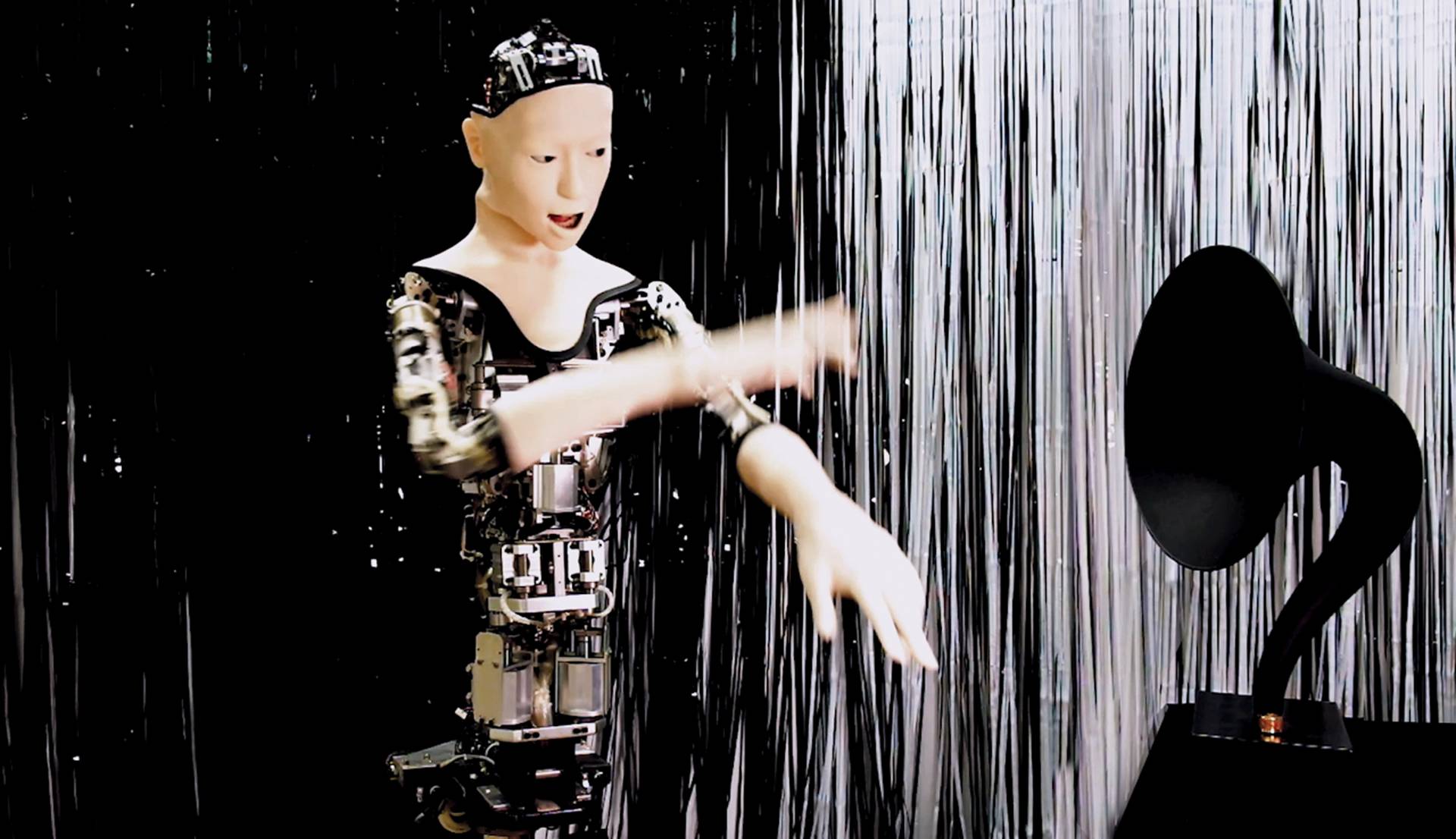
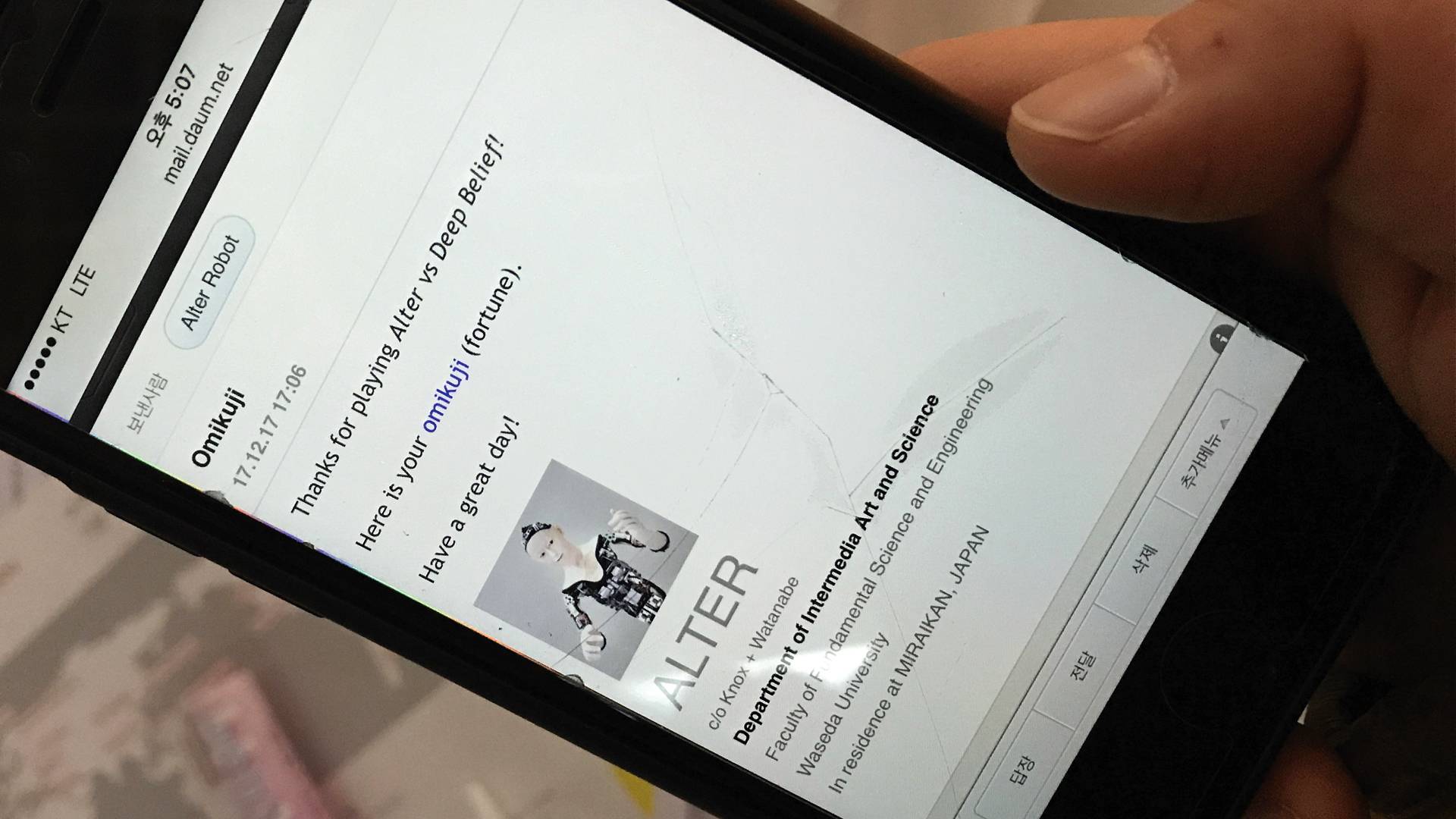
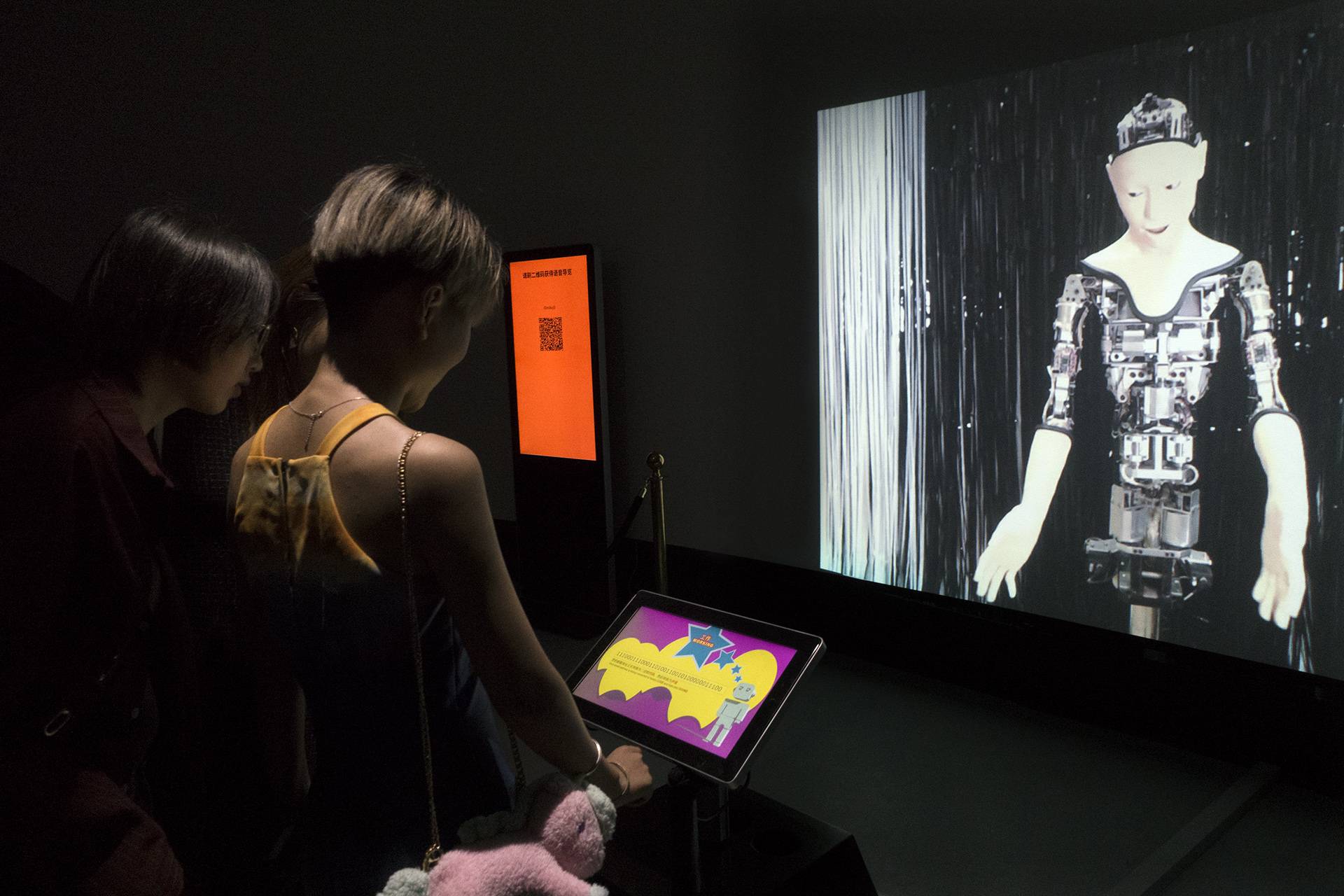
An A.I. robot tells your fortune. Each interactant receives a unique fortune in the form of a personal mini-sound artwork, made expressly for you by our robot and delivered direct to your phone.
Omikuji began as a live-stream event taking place between Japan’s National Museum of Emerging Science and Innovation (Miraikan) and major international art precincts including Artsonje Center in Seoul, 798 Art Zone and CAFA Art Museum in Beijing, Powerlong Art Center in Hangzhou, and Hong Kong City Hall. It is part of Knox+Watanabe’s art–science experiments Alter versus Deep Belief.
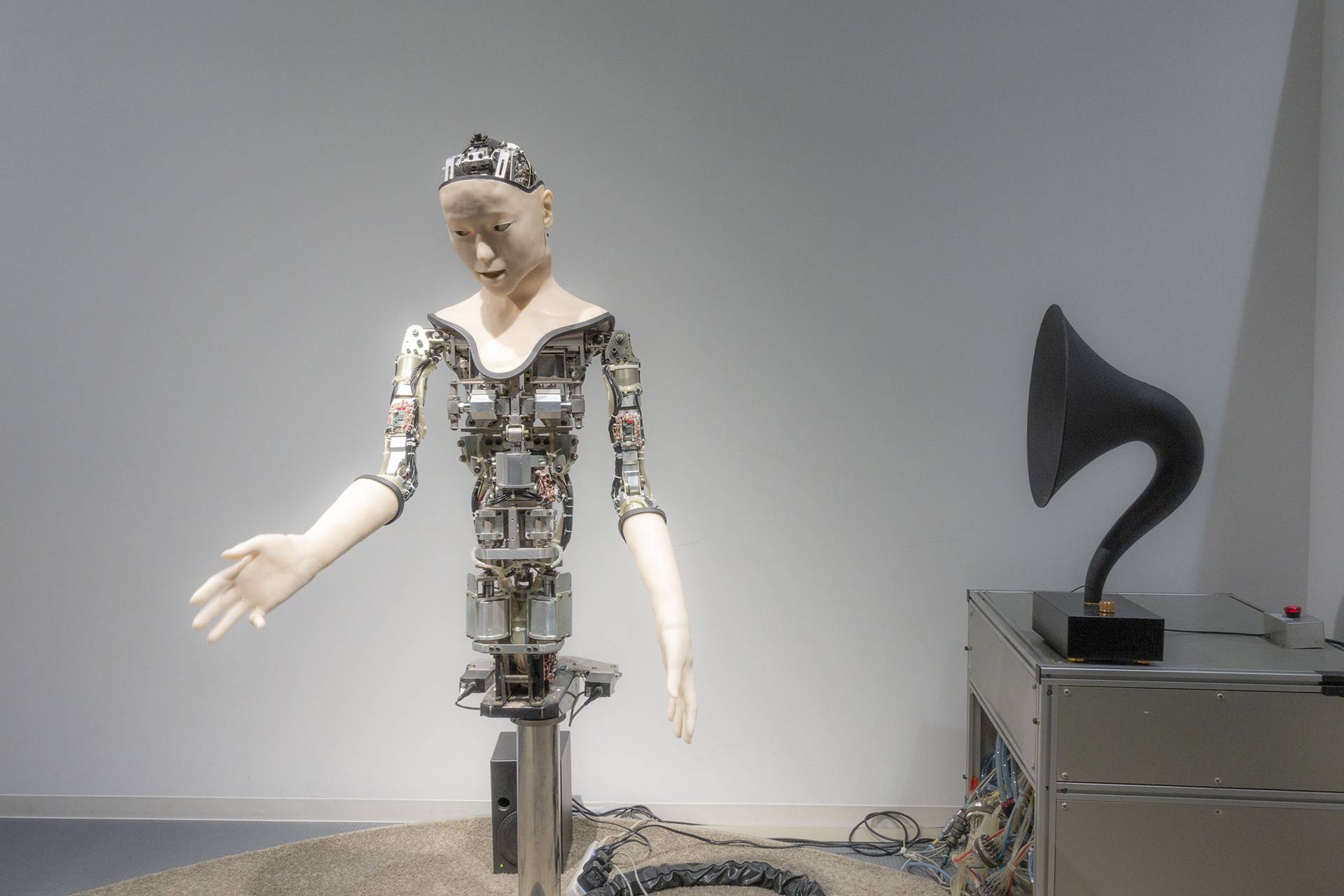
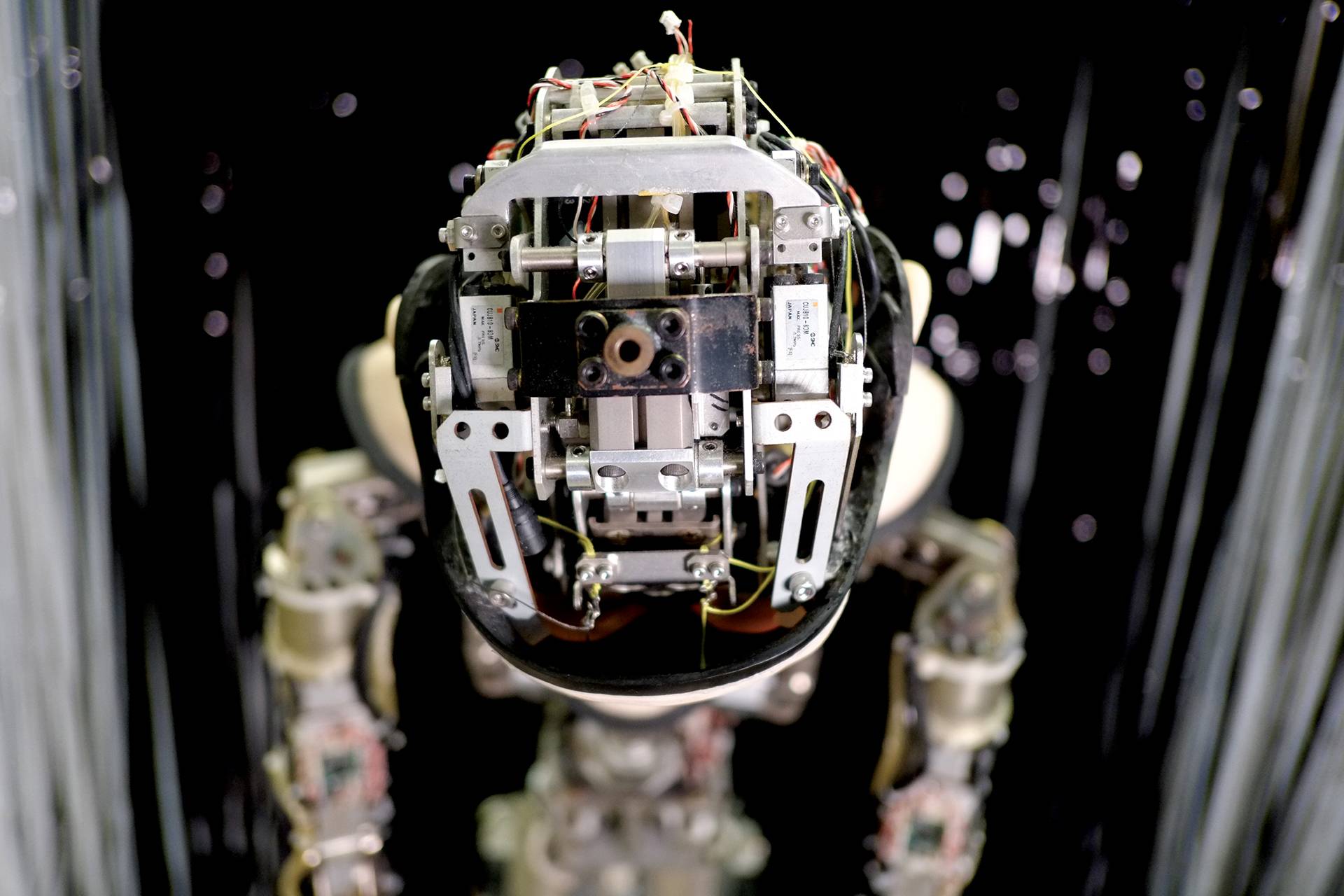
Alter is a Japanese robot with experimental A.I. It is created by Ikegami Lab and Ishiguro Lab, and housed in Japan’s Miraikan museum, where Knox+Watanabe have a lab residency.
Alter can sense, learn, and sing. It uses a self-organising neural network to classify its surroundings. Such A.I. strategies include deep belief networks, through which machines determine certain inputs to be believable. Alter is beginning to believe things about the world.
Omikuji are short personal fortunes obtained at Japanese temples and shrines.
Exhibition visitors are invited to play the artists’ ‘Belief Machine’, to receive omikuji from Alter!
The A.I. concept is made public-user-friendly and visitors gain a sense of the actual spontaneity and responsiveness of the robot’s neural network. They feel a personal connection with it, because each user gets a personal omikuji (fortune) created by the A.I.
Our application interface is bilingual, available in Chinese + English, Korean + English, Japanese + English.
Omikuji was commissioned by Goethe Institut China for the international exhibition A Better Version of You. It is supported by Japan’s National Museum of Emerging Science and Innovation (Miraikan), Waseda University through Japan Science and Technology Agency (JST CREST), and Japan Society for the Promotion of Science. Omikuji is now being developed into an A.I. fortune telling system, with Japanese company Zappallas.
CREDITS
Technical (belief machine): Boris Morris Bagattini, Lindsay Webb
Robot: Takashi Ikegami, Hiroshi Ishiguro, Itsuki Doi, Kohei Ogawa
Thanks: Yukio Yanagawa, Na Chen, Jenna Lee
EXHIBITIONS
Juried exhibition, International Symposium on Electronic Art, Asia Culture Center, Gwangju 2019
Algorithmic Art: Shuffling Space and Time (cur. Lai Linda Chiu Han), Hong Kong City Hall, Hong Kong 2018-19
Beijing Media Art Biennale (cur. Su Xinping, Zhang Zikang, Song Xiewei, Qiu Zhijie, Chen Xiaowen, Fei Jun, Jo Wei , Zhang Wenchao, Xue Tianchong), CAFA Art Museum Beijing, Suzhou Hanshan Art Museum, 2018; Shanghai Ming Contemporary Art Museum, Shenzhen OCT Art & Design Gallery, 2019
9 Tomorrows, China Academy of Art (cur. Yao Dajuin), Powerlong Art Center, Hangzhou 2018
A Better Version of You, Goethe Institut Peking, 798 Art Zone, Beijing 2018
A Better Version of You, Artsonje Center for Contemporary Art, Seoul 2017
ARTIST STATEMENT
Knox+Watanabe make art–science projects exploring sensory and computational perception and conviction in robots and artificial lifeforms.
Recently we have developed a suite of artworks called Alter versus Deep Belief. For these art/experiments, we use the Japanese robot “Alter”, created by Ikegami Lab @ Tokyo University and Ishiguro Lab @ Osaka University. Alter is an android robot with experimental AI stimulated by a sensor-input system.
Art/experiment objectives
We observe how a nascent robot learns and embodies its ‘beliefs’. If the goal of artificial neural networks is for machines to discern phenomena in a humanlike way, Alter is also outputting its discernment of sensory data via its machine body; by this performativity, its belief and behaviour evolve.
In robotic intelligence that mimics human ‘deep belief’, machines are trained to recognise characteristics and then to recreate (infer) them by probability, eventually being able to perform classification tasks. They ‘think’ in layers of computational variables which are inferred from initial, lower layers of direct-measured values — yet each sub-network can only ‘see’ the one that came before it. Layer by layer of accumulated belief, the deep layers of the machine-brain act as truth filters (‘feature vectors’), guiding the learning process.
Belief systems are maximally contentious in our globalised world, and are important to both the inter-harmony and the preservation of culture/s. We create artworks to uncover and express the layers of Alter’s budding belief system, in their naïve mutability and contingency, even their idiosyncrasy.
People may be prompted to ask: How are we transmitting our beliefs to and through machines? How sure are we in our beliefs? How soft are they, and how hard?
KNOX+WATANABE
Elena Knox is a media artist and scholar. Her artworks stage enactments of persona, gender and sonzai kan in technoscience and communications media. Recent shows include: Video Art and Experimental Film Festival, New York; Beijing Media Art Biennale (CAFA Art Museum Shanghai, Hanshan Art Museum Suzhou); Nine Tomorrows, PowerLong Art Center Hangzhou; Algorithmic Art, Hong Kong City Hall; Athens Digital Arts Festival; Cairo Video Festival; Bangkok Biennial; Simultan Festival Romania; Artificial Intelligence Art and Aesthetics Exhibition, Okinawa; A Better Version of You, Artsonje Center for Contemporary Art Seoul and Goethe Institut Beijing. In 2018 she presented her solo show The Female is Future at Gallery Hashimoto, Tokyo.
Knox’s experimental projects are nominated for various awards, recently Australian Art Music Awards and LA Underground Film Forum. She is a researcher in Intermedia Art and Science at Waseda University, Tokyo.
Katsumi Watanabe is a scientist focusing on perception, cognition and action. His research methods encompass interdisciplinary approaches to cognitive science, and real-life applications of knowledge. Project themes include: perceptual distortion of space and time; automation processes of learned sequential actions; implicit processes for decision-making based on preference; implicit learning of visual contexts; implicit motor synchronisation; post-dictive decision making.
Watanabe collaborates closely with AIST (Cognition and Action Research Group, HSBE, Japan), CREST (Japan Science and Technology Agency), and Caltech (Shimojo Lab, USA). He has a PhD in computation and neural systems from the California Institute of Technology, and is Professor at the Department of Intermedia Art and Science, Waseda University, Tokyo.
MORE INFORMATION AND FULL MEDIA LIST
http://elenaknox.com/omikuji.html
Software(s): Max/MspTouchDesigner
Photo Album
Recommended
Autoplay

touch designer缝合时间的裂缝
Virtuality and RealityInteractive ExhibitionInteractiveInteractive Installation
 05:16
05:16 MANA SHOT | 移动靶——新算法下的实体、叙事与秩序生产
MAPPINGVR(Virtual Reality)AR(Augmented Reality)Art VideoInstallationInteraction
 01:20
01:20 老大哥在看着你 -Big Brothers Are Watching You- @ Art Center Nabi
Public ArtInstallationInteraction
冬奥会开幕式揭秘!破冰五环、雪花、一鸽都不能少……黑弓鏖战三年,只为今朝!
视觉视效2022北京冬奥会开幕式Digital ArtDigital VideoInstallation
 00:57
00:57 Deer Garden
Interactive ExhibitionInteractive MappingInteractive VideoSpatial InstallationInteractive Installation

Comments
Please Log in or Register to comment