


 Publish
 Videos
 Articles
 Events
 EN
EN 1080P 1080P
 Add to Channel Download Photo Album 1 Report
Playing issue
Reported video:DUTY
Streaming issue
Progress bar not working
Loading animation issue
Black screen
Other
Description:
Send
DUTY
Performance

 1480
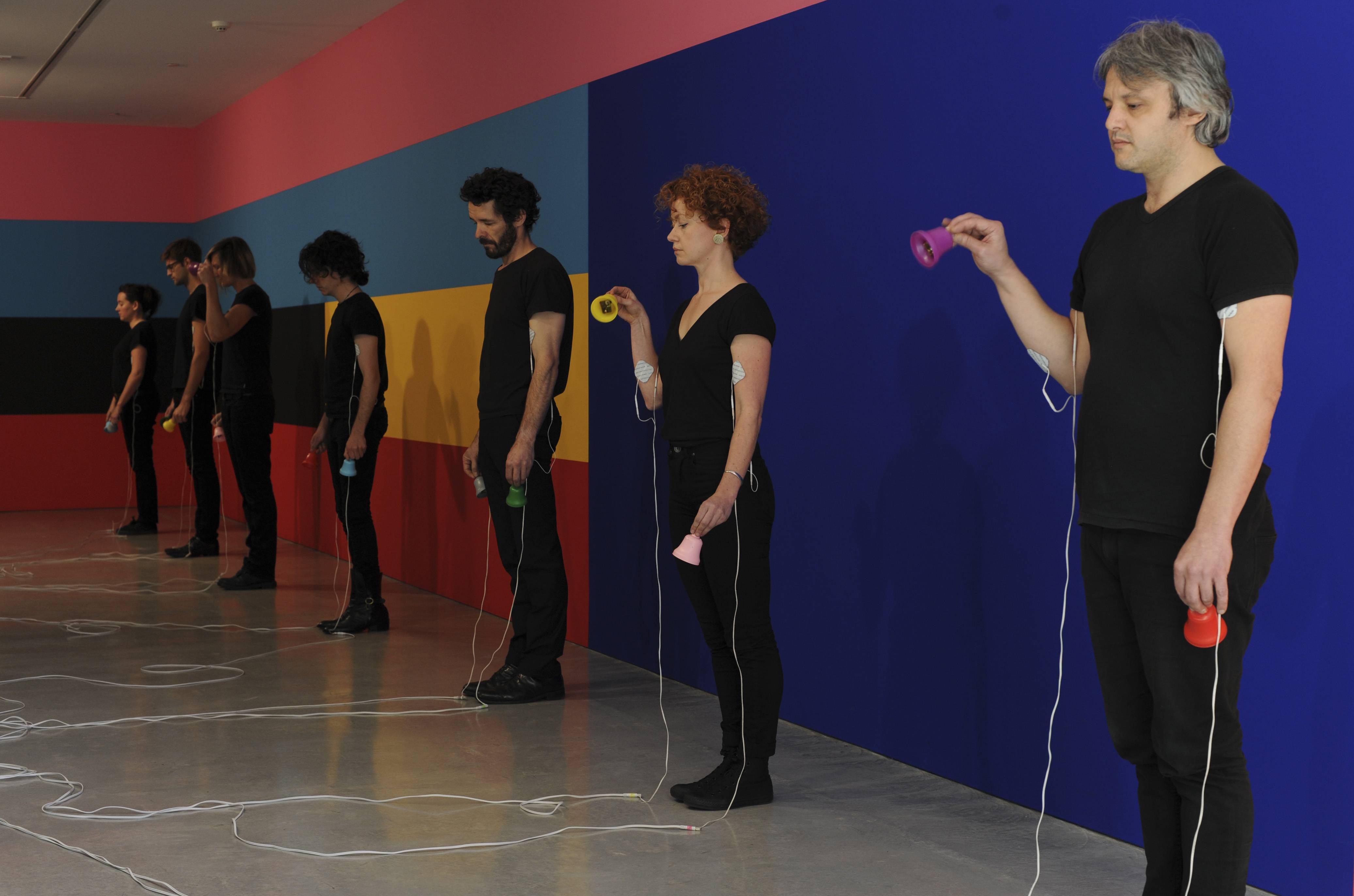
1480Duty explores sonic possibilities and human limits, harnessing the bodily convulsions produced by electrical impulses to control performers in a work composed for fourteen handbells. The title of the work refers both to the movement of a bell and the enforced physical obligation of the performers, and references Pavlovian classical conditioning experiments pairing the sound of a bell with another stimulus to elicit conditioned responses in subjects.
A composition converted to MIDI triggers two custom-built EMS devices, which deliver electrical impulses to specific points on the performers’ arms via electrodes attached to their skin, causing their muscles to contract and generating specific involuntary movements at changing velocities. Variations in voltage, frequency and pulse width dictate different muscular responses in the performers, ranging from unnatural jolts to unnervingly fast movements.
Expanding the potential of the human body beyond conscious control the use of electric muscle stimulation in this context enables experimentation with rhythmic structures and fast movements that the performers would be unable to achieve of their own volition. The ensemble of performers create a unified somatic instrument; a conduit for complex rhythmic soundscapes and visually unnerving movements.
The application of EMS to musical performance provides a novel way to explore the interface between technology and live performance, and raises interesting questions regarding creative agency in the creation of music. The transmogrification of the performers’ body as an input/output device literalizes aspects of musical performance, where musicians frequently describe feeling like conduits or transcribers of a creation that is not their own. A perverse take on Schoenberg’s (1911) claim that “art is born not of ‘I can’ but of ‘I must’”, Duty explores the liminal space between didactic execution and free interpretation inherent in all musical performance.
In a broader sense, Duty questions assumptions about agency and free will both in musical performance and everyday contexts. An enquiry into the nature of agency within systems where cognition is distributed across people, objects and environment through technologies of connection, Duty explores what happens when embodied experience is disrupted or extended, and what kind of agency is created in these distributed systems.
A composition converted to MIDI triggers two custom-built EMS devices, which deliver electrical impulses to specific points on the performers’ arms via electrodes attached to their skin, causing their muscles to contract and generating specific involuntary movements at changing velocities. Variations in voltage, frequency and pulse width dictate different muscular responses in the performers, ranging from unnatural jolts to unnervingly fast movements.
Expanding the potential of the human body beyond conscious control the use of electric muscle stimulation in this context enables experimentation with rhythmic structures and fast movements that the performers would be unable to achieve of their own volition. The ensemble of performers create a unified somatic instrument; a conduit for complex rhythmic soundscapes and visually unnerving movements.
The application of EMS to musical performance provides a novel way to explore the interface between technology and live performance, and raises interesting questions regarding creative agency in the creation of music. The transmogrification of the performers’ body as an input/output device literalizes aspects of musical performance, where musicians frequently describe feeling like conduits or transcribers of a creation that is not their own. A perverse take on Schoenberg’s (1911) claim that “art is born not of ‘I can’ but of ‘I must’”, Duty explores the liminal space between didactic execution and free interpretation inherent in all musical performance.
In a broader sense, Duty questions assumptions about agency and free will both in musical performance and everyday contexts. An enquiry into the nature of agency within systems where cognition is distributed across people, objects and environment through technologies of connection, Duty explores what happens when embodied experience is disrupted or extended, and what kind of agency is created in these distributed systems.
Photo Album




Comments
Please Log in or Register to comment