


 Publish
 Videos
 Articles
 Events
 EN
 1080P 1080P
Add to Channel Download Photo Album 2 Report
Playing issue
Reported video:FLORAS_CHENGDU
Streaming issue
Progress bar not working
Loading animation issue
Black screen
Other
Description:
Send
FLORAS_CHENGDU Original

 1695
Creators

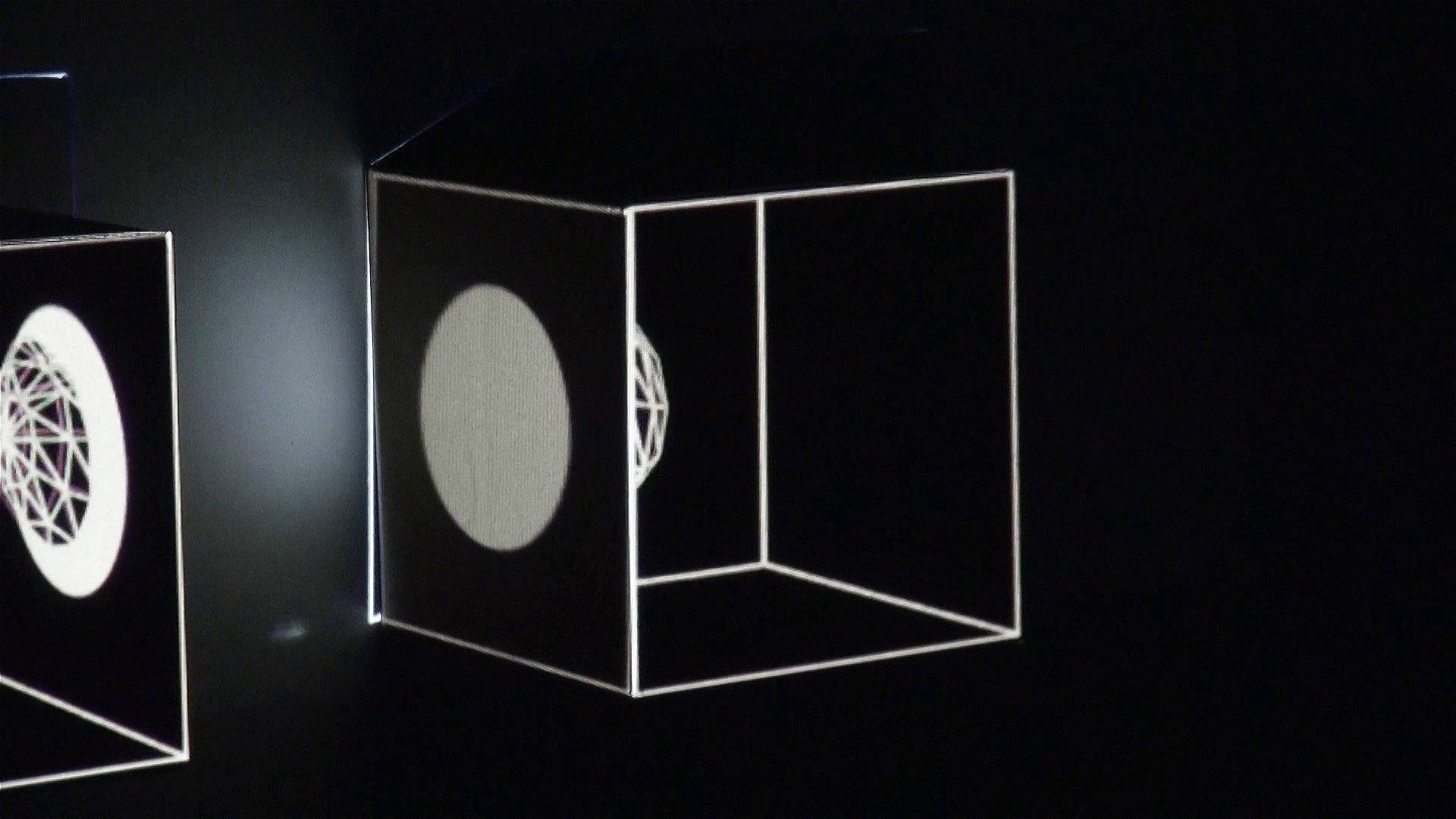
FLORAS_CHENGDU is a generative video installation — a new version of an ongoing series initiated in 2020. A garden of light that never repeats itself. One hundred fractal animations cohabit, attract, repel, and mutate, organized by evolutionary rules that ask whether human perception of the natural world can still be separated from how machines make sense of their own observations.
Oscillating between the abstract and the representational, the photo-real and the pictorial, FLORAS_CHENGDU uses an analog optical-electronic system to reflect on contemporary entanglements of technology, nature, and perception. The work is a light-cinema of pulsing fractal images.
The hundred building blocks of FLORAS_CHENGDU are not generated in software alone. They emerge from an analog video-feedback apparatus: projectors, video cameras, and custom systems for motorized iris, pan, and rotation control. Each image is born from the infinite replication of the projection screen folded back through the lens — the classical optical loop that has generated fractal pattern in moving-image work since the Vasulkas. The medium is the material. The hardware is the language.
A custom program organizes the field. It updates the visualization through two combinatorial rules — attraction and repulsion — and one operation: mutation. As in Conway's Game of Life, every animation senses its four neighbors and moves toward one of them. Videos are attracted by difference in shape and color: a red fractal loves a green one; two green fractals flee each other. When two fractals overlap, the system generates new offspring, derived from the combination of their parents and altered by random mutations rendered in real time. The whole reconfigures itself continuously, from the interaction of its parts. The visitor may return to the work infinitely; the work will never be the same.
Immersed in the field, the visitor reads the garden: endless ferns, flowers, forests, clouds, and whatever else perception allows. The hardware behind these images is not new or rare. Video cameras and projectors live everywhere now: in streets, homes, schools, elevators, cars, surgical instruments, satellites, drones, in our bodies. We have grown so used to them knowing what to do — seeing, focusing, balancing light and color, recording — that they have become transparent. We no longer pay attention to their processes, to the languages they speak. The oneiric, lysergic universes of FLORAS_CHENGDU — galaxies, fractal gardens — induce the mind to associate the results with natural phenomena. Visitors commonly attribute the system's behavior to a film, a computer animation, a pre-programmed routine. They are wrong on all three counts.
FLORAS_CHENGDU is conceived site-specifically for Eastern Suburb Memory. The site once manufactured televisions, monitors, and cathode-ray tubes — images for mass consumption, produced by the same family of optical-electronic devices that FLORAS now uses to produce images that no longer repeat. The work proposes a material continuity with that industrial past: where the site once fabricated screens, FLORAS fabricates images, through the same analog grammar. The garden is what grows on the ruins of the factory.
FLORAS_CHENGDU includes a sonic dimension — a generative audio composition built from field recordings of birdsong, gardens, and water, mixed continuously by an automated VJ logic that mirrors the combinatorial rules of the visual system. This dimension is available for site-specific expansion.
And the work asks: are machines evolving on their own? What happens when machines do things by themselves?
Cover image and work documentation: FLORAS, São Paulo 2021 — photograph © Carol Quintanilha. FLORAS at SESI Paulista Digital Gallery, São Paulo 2026 — photograph © Rejane Cantoni. FLORAS 2022 — photograph © Renato Mangolin.
Photo Album


Recommended
Autoplay
 02:44
Foreseeing Future Architectural Legacies
建筑遗产AIGameInteractiveInteractive Installation
JOURNEY TO THE OPERA FUTURE-IMMERSIVE ROBOTIC OPERA ROCK CONTEMPORARY THEATER
Audition & PerformanceVideoInstallation



 02:06
「鲜榨的自我生成」-生成人观看生成空间
Extended RealityVirtuality and RealityAudition & PerformanceInteractive VideoSpatial Installation

Comments
Please Log in or Register to comment