


 Publish
 Videos
 Articles
 Events
 EN
 1080P 1080P
Add to Channel Download Photo Album 7 Report
Playing issue
Reported video:AI诗歌与方言
Streaming issue
Progress bar not working
Loading animation issue
Black screen
Other
Description:
Send
AI诗歌与方言 Original

 3415
At present, with the exponential development of artificial intelligence technology, creators will face the era of deep cooperation with artificial intelligence. AI Poetry and Dialect, an experimental work, tries to explore how to create art under the cooperation of artificial intelligence, effectively convey the in-depth academic analysis of the Yangtze River culture to a wider public, and then enhance the understanding and appreciation of the economic, historical and cultural values of the Yangtze River on a global level.
In the collaborative design and creation of artificial intelligence, it is divided into five links, namely, poetry collection and training, poetry generation and dialect reading, font design, picture generation of landmark buildings and interactive module writing.
The five links are progressive layer by layer, forming a complete AI design and interaction process.
The natural composition of the Yangtze River basin blends with the rich historical records, social interaction and humanistic practice in the region, and jointly shapes a cultural landscape that not only shows the beauty of nature, but also integrates the humanistic spirit. The geographical environment, climatic conditions and living customs in different areas of the Yangtze River Basin will all affect the development of local dialects and make them produce their own vocabulary and phonetic rules. Therefore, dialect is not only a linguistic phenomenon, but also a reflection of cultural identity and social belonging.
However, with the advancement of globalization and the trend of cultural homogenization, dialects and cultural characteristics in the Yangtze River basin are facing the threat of disappearance. The series "Records of Endangered Languages in China" points out that among the more than 130 languages in China, 68 have a population of less than 10,000, 48 have a population of less than 5,000, 25 have a population of less than 1,000, and only a dozen or even a few people can speak some languages. People have less opportunities to use dialects, which will affect their cultural identity and self-identity, and at the same time lead to the loss of collective memory, forcing the weakening of local sense, local attachment and local identity. Therefore, this study hopes to combine the dialects of the Yangtze River valley with the expressions of China's traditional poems through artificial intelligence collaborative artistic creation, so as to arouse the public's memory of the dialects of the Yangtze River valley.
The Yangtze River basin covers 19 provincial administrative regions. In this creation, Sichuan, Hunan, Hubei, Shaanxi, Anhui, Shanghai, Henan and Shandong provinces were selected as representative cities of dialect pronunciation. For example, in Sichuan dialect, monosyllabic or polysyllabic affixes can be added before and after the root of adjectives to form a vivid form to express different States or emotional colors. Hunan dialect is exaggerated in the use of adverbs and adjectives, pursuing humor and highlighting itself, and likes to speak with suffix sounds such as "Bo" and "Sa". In Shanghai dialect, the tongue beats frequently and deftly, and the use of mouth shape focuses on the lips and chin, with a small range of high-frequency changes.
After selecting the above eight provinces and cities, I made artificial intelligence poetry creation according to the different names of the eight provinces and cities where the Yangtze River flows. In this poetry creation, I fixed the poetry style in the Tang Dynasty, combined with the poetry styles of poets such as Du Fu, Li Bai, Wang Wei and Bai Juyi to carry out model training, and then called different dialect speakers to recite the poems generated by the algorithm with the help of TTS pronunciation technology in Iflytek.
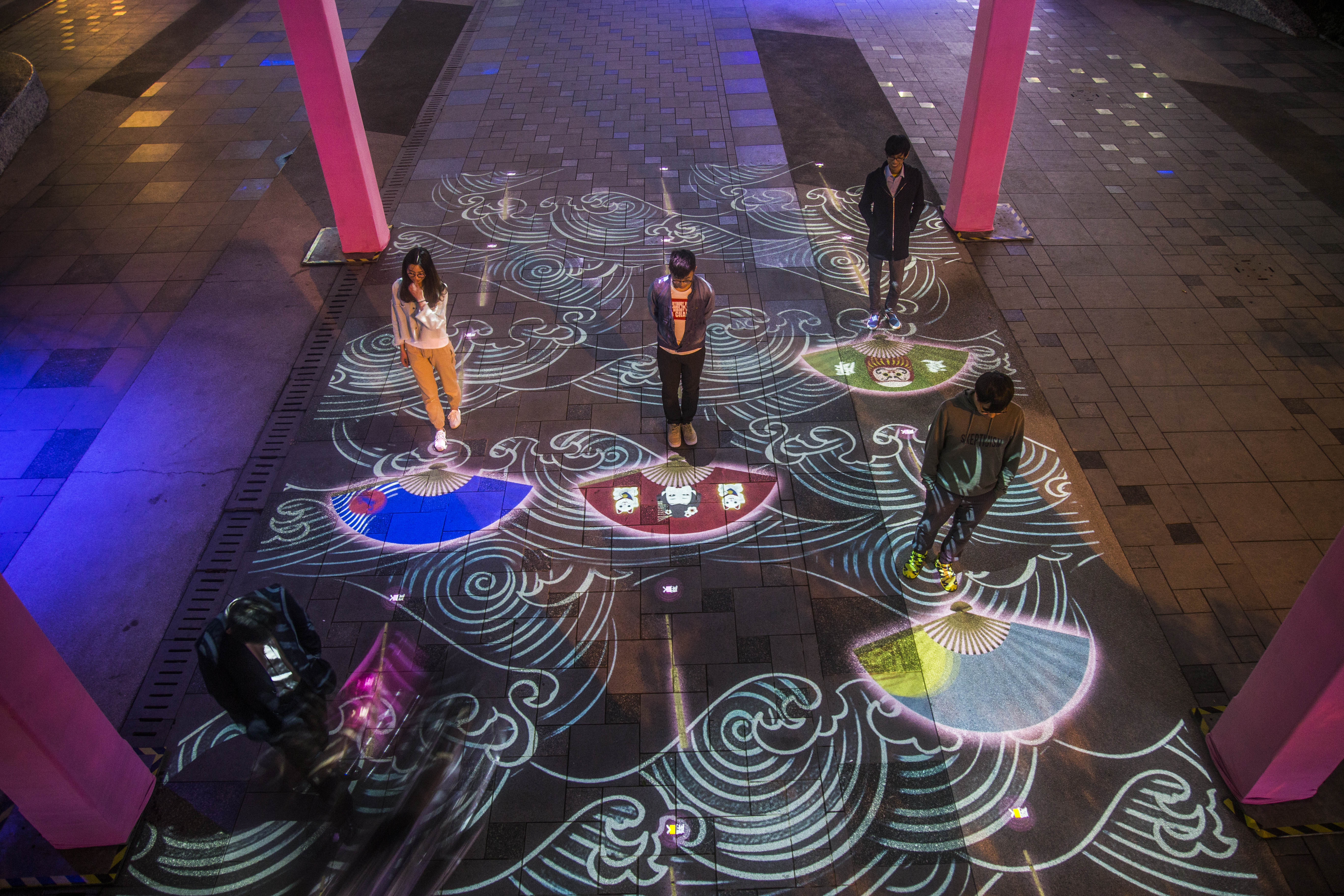
Finally, this work uses stable diffusion to interact with TouchDesigner across platforms, designs fonts for the names of provinces and cities, combines the natural scenery of eight different provinces and cities in China to create a series of unique urban characteristic buildings, and combines radar sensors to connect visual effects with interactive hardware. When the audience enters the space, the name of a city will appear randomly on the ground. The audience needs to step on this lit city with their feet, and send an interactive signal to TouchDesigner software through radar data, and the corresponding visual picture and dialect poetry sound will appear.
The works of AI Poetry and Dialect realize the creative transformation and innovative development of the context of the Yangtze River with the help of emerging digital technology. Based on the academic development trend of interdisciplinary integration, it explores the role of media technology in promoting social and cultural innovation, advocates that design practice should assume global ecological and cultural responsibilities, emphasizes the importance of designing and constructing social values, and at the same time promotes the recognition and respect for local culture. It is hoped that the presentation of this work will promote the spread of the symbols of the Yangtze River and enhance the public's perception, recognition and participation in the Yangtze River culture.
Photo Album


Recommended
Autoplay

 02:44
Foreseeing Future Architectural Legacies
建筑遗产AIGameInteractiveInteractive Installation
 02:49
一次突破,全心感受-绿地中心沉浸式展厅
MAPPINGProduct DesignSpace DesignPublic ArtArt VideoInstallationInteraction
 01:04
平昌冬奥会_三星品牌工作室(Samsung Galaxy Brand Studio)“Infinity Moment”
Space DesignPublic ArtArt VideoInstallation


Comments
Please Log in or Register to comment