


- Report
English
Today, 22 November 2026, is the last day of Piksel26, Bergen's free festival for art and free technology, at Bergen Assembly. Under the title From Compost to Code: Reimagining Radical Computing, the exhibition places Shinji Toya's compost-powered computer beside a VR comic, a multiplayer game about a ruined border bridge, and three immersive works from Peru.
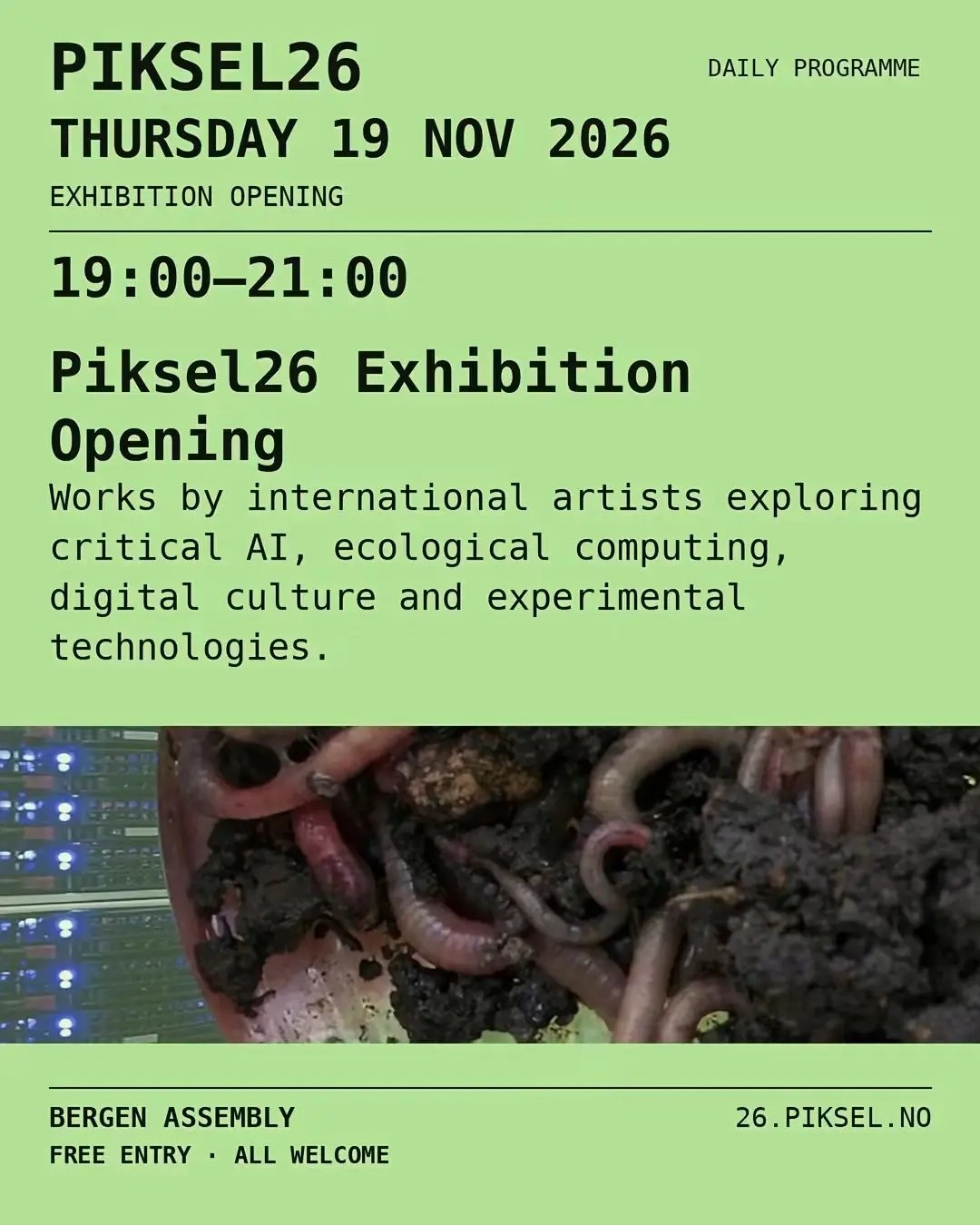
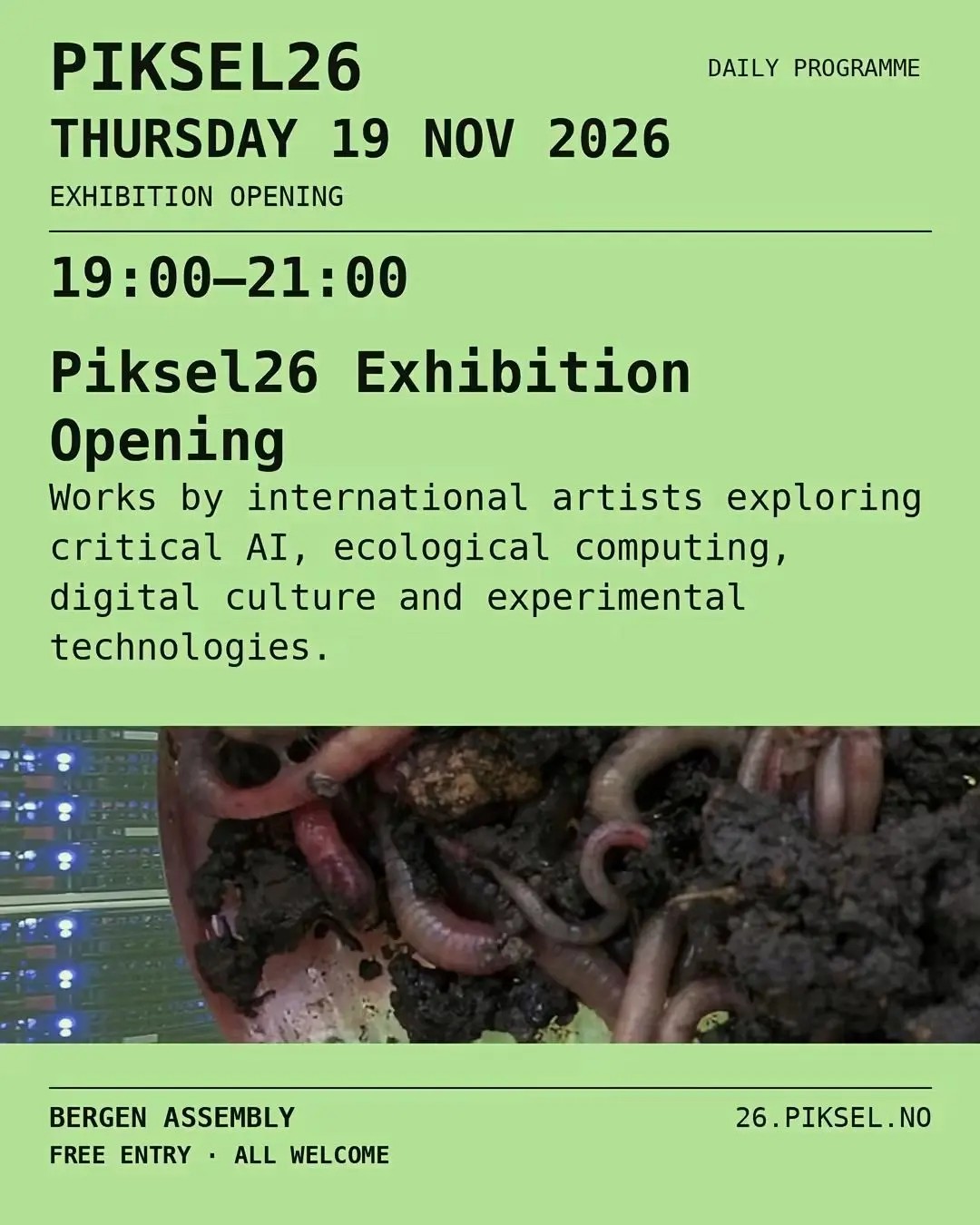
Official Piksel26 exhibition-opening announcement for Thursday 19 November 2026, published by Kill Screen on 20 November with the credit ‘Image courtesy Piksel.’ The lower band shows worms in compost, not a photograph of the Bergen Assembly installation. Official festival announcement graphic.
A free four-day festival at Bergen Assembly
Piksel, in its twenty-fourth edition, opened the exhibition on 19 November and runs it today from 10:00 to 19:00. All activities are free; the two compost workshops on Saturday required registration by email. A seminar, From Compost to Code: Reimagining Radical Computing, was held yesterday, 21 November, at Bergen Assembly and streamed on Piksel's Twitch channel, with concerts and artist presentations also listed for 21 and 22 November. The programme draws on work from the Critical Climate Computing initiative with FutureEverything and the University of the Arts London, and on a local collaboration with Norsk Permakulturforening and its Bergen branch.
A computer that follows the pace of microbes
Shinji Toya's Microbial Feral Computing with a Compost Computer is described on the official festival pages as a work in progress. Toya explores microbial fuel cells — bio-batteries that turn microbial activity into electricity — to power a small, low-energy computer. A slow, abstract web animation uses simulated fluctuations in that energy to suggest rhythms that may barely register during a visit; the official text cites Bridget Riley's op art for its low-energy, dark-mode look, and Anna Tsing's ‘feral effects’ for the way microbes disrupt human expectations of control. The work was developed during a residency at V2_ Lab for the Unstable Media in Rotterdam and is co-produced by Toya and V2_.
Process photographs published on Piksel's official page for From Compost to Code, showing microbial fuel-cell trays, stacked bins with wiring, and two people working with compost containers outdoors. Official process images, not photographs of the Bergen Assembly exhibition this weekend.
Yesterday's second workshop, led by Toya, invited participants to measure electrical power from compost, build a small server on a microcontroller, compress images for upload, and look at a working prototype of a compost-computer server that the artist brought with him. The official description presents this less as a finished machine than as an experiment in computing as a reciprocal relationship with living systems.
A VR comic, a ruined bridge, and three works from Peru
Malte Steiner's Anticomic is an immersive VR installation, built in the open-source engine Godot, that asks visitors to move through the black-and-white graphic language of comics with the narrative stripped out. NSA Kollektiv, a Spanish-Norwegian group, shows Brostein for (de)konstruksjon / Adoquines para el Guadiana, a speculative multiplayer game that turns the ruined Ajuda Bridge between Spain and Portugal into a place for collectively negotiating a shared territory. Gustavo Romano's Shadowgrams is described as a device that intervenes in photographs and their data layers, to challenge the algorithms that classify images on social media.
Three immersive works arrive through the Peruvian organisation ASIMTRIA, listed on the festival site as Daniel Laureano's Ocupi, Sofía Rubio Ly's León Muchik — described as a virtual encounter between Chinese and Moche cultures on Peru's northern coast — and Blanca Jurado's Almacunapacc, an immersive-video requiem dedicated to those who suffered under colonial mita mining. Friday also included a 113-minute essay film on Stadtwerkstatt, Linz's long-running autonomous art space.
Observations (interpretation)
While other events this weekend treat monuments as screens, Piksel asks whether a computer should be allowed to run at the speed of a compost heap. The useful idea for a platform is not a more spectacular machine, but a public, unfinished prototype: open tools, a work in progress, and a tempo that may not repay a short visit. That is a different kind of ambition from a six-minute mapping that has to land on the hour.
Images are the official opening announcement (courtesy Piksel, via Kill Screen) and official process photographs from piksel.no, not independently made records of this weekend's exhibition. Images are official press or event images. MANA publication rights have not been cleared. The author has not visited the exhibition.
Sources
Piksel26 official site — https://26.piksel.no/
From Compost to Code programme page — https://26.piksel.no/2026/10/25/hello-world/
Piksel26 programme — https://26.piksel.no/2026/10/31/program/
Kill Screen, 20 November 2026 — https://www.killscreen.com/piksel26-pairs-a-vr-comic-with-a-compost-computer/
中文
今天,2026年11月22日,是卑尔根免费的艺术与自由技术节 Piksel26 在 Bergen Assembly 的最后一天。展览以《From Compost to Code: Reimagining Radical Computing》为题,把户矢真司(Shinji Toya)靠堆肥供电的电脑,放在一部VR漫画、一款关于一座残破边境桥的多人游戏,以及三件来自秘鲁的沉浸式作品旁边。
Piksel26 于2026年11月19日(周四)展览开幕的官方预告,由 Kill Screen 在11月20日刊出,并注明 Image courtesy Piksel。下方条带是堆肥里的蚯蚓,并非 Bergen Assembly 展场照片。官方节日预告图。
在 Bergen Assembly 举办的四天免费节日
第二十四届 Piksel 于11月19日开幕,今天的展览时间是10:00至19:00。所有活动免费;周六两场堆肥工作坊需提前发邮件报名。研讨会《From Compost to Code: Reimagining Radical Computing》已于昨天11月21日在 Bergen Assembly 举行,并在 Piksel 的 Twitch 频道直播;21日和22日也安排了音乐会和艺术家分享。节目依托 Critical Climate Computing 倡议与 FutureEverything、伦敦艺术大学的合作,以及与挪威永续农业协会及其卑尔根分会的本地合作。
一台跟上微生物节奏的电脑
户矢真司的《Microbial Feral Computing with a Compost Computer》在官方节日页面上被写成一件进行中的作品。他探索微生物燃料电池——把微生物活动转化成电的生物电池——为一台小型、低能耗的电脑供电。一段缓慢、抽象的网络动画,用模拟的能量波动去暗示一种来访时可能几乎察觉不到的节奏;官方文本提到 Bridget Riley 的欧普艺术,以说明其低能耗、深色模式的外观,并以 Anna Tsing 的「野性效应」来说明微生物如何打断人类对控制的预期。作品在鹿特丹 V2_ 不稳定媒体实验室驻留期间发展,由户矢与 V2_ 共同制作。
Piksel 官网《From Compost to Code》页面发布的过程照片:微生物燃料电池托盘、带接线的堆叠箱,以及两人在户外处理堆肥容器。官方过程图像,并非本周末 Bergen Assembly 展览现场的照片。
昨天第二场由户矢主持的工作坊,邀请参与者测量堆肥产生的电力,用微控制器搭一座小服务器,压缩图像并上传,并观看艺术家带来的堆肥电脑服务器原型。官方描述更接近一次实验:把计算看成与生命系统的互惠关系,而不是一台已经完成的机器。
一部VR漫画、一座残桥,以及三件来自秘鲁的作品
Malte Steiner 的《Anticomic》是一件沉浸式 VR 装置,用开源引擎 Godot 制作,请观众走入被抽掉叙事的黑白漫画语言。西班牙与挪威的 NSA Kollektiv 展出《Brostein for (de)konstruksjon / Adoquines para el Guadiana》,一款思辨性的多人游戏,把西班牙与葡萄牙之间残破的 Ajuda 桥,变成共同协商共享领土的地方。Gustavo Romano 的《Shadowgrams》被说明为一种介入照片及其数据层的装置,用以挑战社交媒体上分类图像的算法。
三件沉浸式作品通过秘鲁组织 ASIMTRIA 到来,节日网站列出的是 Daniel Laureano 的《Ocupi》,Sofía Rubio Ly 的《León Muchik》——被描述为秘鲁北部海岸上中国文化与莫切文化的一次虚拟相遇——以及 Blanca Jurado 的《Almacunapacc》,一部献给殖民时期米塔采矿制度下受难者的沉浸式影像安魂曲。周五还放映了一部113分钟的文章电影,关于林茨长期存在的自治艺术空间 Stadtwerkstatt。
观察与思考(以下为观点)
当这个周末的另一些活动把纪念碑当成屏幕,Piksel 问的是:一台电脑是否可以被允许按堆肥的速度运转。对一个平台来说,值得带走的不是更壮观的机器,而是一个公开、尚未完成的原型:开放的工具,一件进行中的作品,以及一种不一定回报短暂停留的时间感。这和必须整点落下的六分钟映射,是另一种野心。
图像为官方开幕预告(由 Piksel 提供,经 Kill Screen 刊出)以及 piksel.no 上的官方过程照片,并非本周末展览的独立纪录。图像为官方新闻或活动图像。MANA的转载使用权尚未确认。作者并未实地参观。
资料来源
Piksel26 官网 — https://26.piksel.no/
From Compost to Code 节目页 — https://26.piksel.no/2026/10/25/hello-world/
Piksel26 节目单 — https://26.piksel.no/2026/10/31/program/
Kill Screen,2026年11月20日 — https://www.killscreen.com/piksel26-pairs-a-vr-comic-with-a-compost-computer/
 0
 0
 0





 Publish
 Videos
 Articles
 Events
 EN




Comments
Please Log in or Register to comment