


- Report
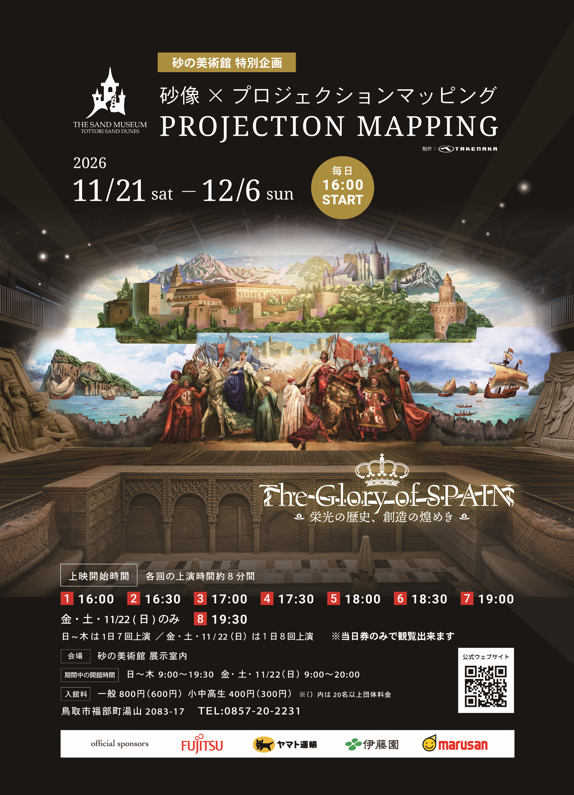
Today, 21 November 2026, the Sand Museum at the Tottori Sand Dunes opens its winter projection-mapping programme, The Glory of Spain — A Fantasia of Sand and Light. The screenings, produced by Takenaka Co., run through 6 December and are mapped onto two large sand sculptures of Spanish landscapes and history already standing in the galleries.
Official key visual for the 2026 projection-mapping programme, published on the Sand Museum news page announcing the 21 November–6 December run. The poster composites brightly coloured historical imagery onto the two-tier sand sculptures and overprints the title The Glory of Spain. It is a designed official poster, not an unaltered photograph of a live screening.
The museum’s own overview for the press, issued ahead of opening, calls this the eleventh edition of its winter mapping programme. The 2026 title is given as The Glory of Spain — A Fantasia of Sand and Light (砂と光のファンタジア The Glory of Spain —栄光の歴史、創造の煌めき). Screenings start today and run daily through 6 December, from 16:00, every thirty minutes. Each showing lasts about eight minutes. Sunday to Thursday there are seven screenings, the last at 19:00; on Fridays, Saturdays and Sunday 22 November there is an eighth showing at 19:30. Between screenings, the official notice says, the sand sculptures remain lit.
An opening ceremony is listed for today at 15:55 in the second-floor galleries, with remarks from the mayor of Tottori, followed by the first public screening at 16:00. A press preview was held yesterday, 20 November, from 16:00, after a test projection at 15:00; the museum’s general producer, Chaen Katsuhiko (茶圓勝彦), is named as the speaker. NHK reported the preview on the evening of 20 November.
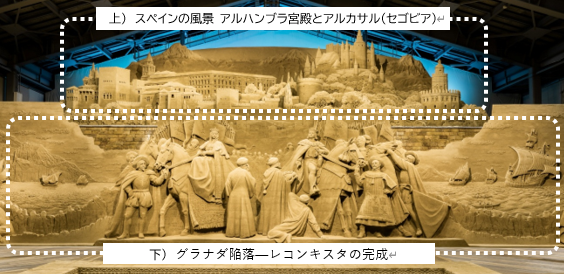
Official labelled photograph of the two sand sculptures used as the projection surface, published on the museum’s overview page. The upper work is identified as Spanish Landscape — the Alhambra and the Alcázar (Segovia); the lower as The Fall of Granada — Completion of the Reconquista. The image documents the sculptures themselves, not a moment of the 2026 mapping.
The mapping is not thrown onto a blank façade. It is designed for two sculptures already built for the museum’s current Spain-themed exhibition, “A World Tour in Sand: Spain.” The upper work is Spanish Landscape — the Alhambra and the Alcázar (Segovia); the lower is The Fall of Granada — Completion of the Reconquista. Together, the official pages say, they measure about ten metres high by twenty metres wide. Visitors watch from the second-floor galleries and from the third-floor corridor.
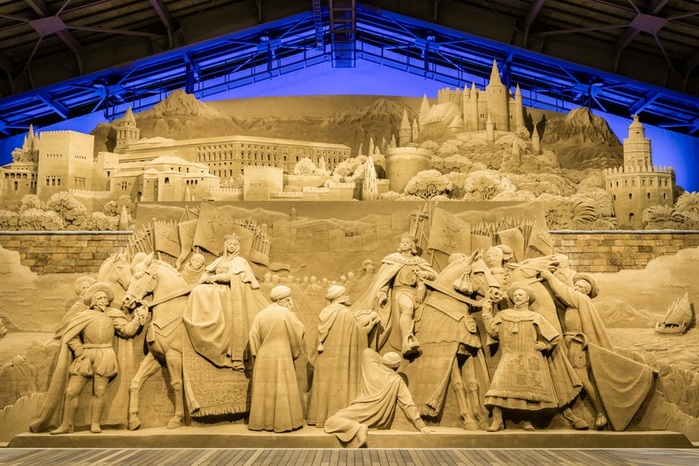
Official photograph of the two Spain-themed sand sculptures in the Sand Museum galleries, published on the museum’s 2026 mapping news page. The picture shows the sculpted surface under museum lighting, not a documented frame from the eight-minute projection.
The official synopsis says the programme focuses on the “light” of Spanish history, colouring the sand with subjects and ornamental patterns from successive periods. The scenes listed are: the long contest between the Christian and Islamic worlds from the Roman period onward; the completion of the Reconquista and the birth of a Christian Spanish kingdom; the arrival of Columbus’s Santa María and the opening of an empire “on which the sun never set”; the appearance of the Sagrada Família, described as a work left for the future by Antoni Gaudí in the centenary year of his death; and a finale in which the whole sculpture is dressed in the tiles of Gaudí’s architecture. The Embassy of Spain in Japan is named as a patron. The moving image itself is credited to Takenaka Co. (株式会社タケナカ), a company founded in 1926 as a projector manufacturer and now working in rental, installation and operation of image and sound.
Admission to the mapping is the ordinary museum ticket: 800 yen for adults and 400 yen for elementary, junior-high and high-school students, with group rates and free entry for children younger than elementary-school age. During the run the museum lists Sunday–Thursday hours as 9:00–19:30, last entry 19:00, and Friday, Saturday and 22 November hours as 9:00–20:00, last entry 19:30.
Heritage mapping often treats a building as a convenient rectangle. Here the screen is already a sculpture, with its own depth, its own heroes, and its own very loaded history — the Reconquista included — before a single projector is switched on. The useful idea is not only that sand can take light, but that the surface came first, and that an eight-minute cycle has to live with a form that will still be there, quietly lit, when the film is over.
The cover is the official 2026 poster, a designed composite, not an unaltered live-screening photograph. The labelled diagram and the wide gallery photograph document the sand sculptures themselves, not a frame of the mapping. Images are official press or event images. MANA publication rights have not been cleared. The author has not visited the exhibition.
今天,2026年11月21日,鸟取砂丘砂之美术馆(砂の美術館)开幕冬季投影映射项目《砂与光的幻想曲 The Glory of Spain——荣光的历史,创造的闪耀》。由株式会社竹中(タケナカ)制作的映像将持续放映至12月6日,投射在展厅里已经立起的两座大型西班牙主题砂像上。
2026年投影映射项目的官方主视觉,刊于砂之美术馆宣布11月21日至12月6日举办的新闻页。海报把色彩鲜明的历史画面合成在两层砂像上,并叠印标题《The Glory of Spain》。这是设计过的官方海报,并非一场放映的未经处理现场照片。
馆方在开幕前发给媒体的概要中,把今年写成冬季投影映射的第11回。2026年的标题是《砂与光的幻想曲 The Glory of Spain——荣光的历史,创造的闪耀》。放映从今天起到12月6日每天举行,16:00开始,每30分钟一场,每场约八分钟。周日到周四共七场,最后一场19:00;周五、周六以及11月22日周日加一场19:30。官方通知还写明,在放映间隙,砂像会保持灯光照明。
今天15:55,二层展厅将举行开幕仪式,由鸟取市长致辞,随后16:00开始第一场对公众放映。内览会已于昨天11月20日16:00举行,15:00还有一次与正式放映相同的试投影;馆方综合制作人茶圓勝彦被列为致辞者。NHK 在20日晚报道了这场内览。
用作投影面的两座砂像的官方标注照片,刊于馆方概要页。上层被标明为《西班牙的风景——阿尔罕布拉宫与塞哥维亚的阿尔卡萨尔》;下层为《格拉纳达陷落——收复失地运动的完成》。照片记录的是砂像本身,并非2026年映射放映的瞬间。
这次映射并不是投在一块空白墙面上,而是为馆内正在展出的“砂之世界旅行·西班牙”主题展中已有的两座主砂像专门制作的。上层是《西班牙的风景——阿尔罕布拉宫与塞哥维亚的阿尔卡萨尔》,下层是《格拉纳达陷落——收复失地运动的完成》。官方页面写道,两座合在一起约高十米、宽二十米。观众可从二层展厅和三层回廊观看。
西班牙主题两座砂像的官方照片,刊于美术馆2026年映射新闻页。照片呈现的是馆内灯光下的雕塑表面,并非这条约八分钟映像中被记录下来的一帧。
官方梗概说,节目把焦点放在西班牙历史中的“光”,用各时代的题材和装饰纹样去为砂像上色。列出的主要场面包括:自古罗马以来基督教世界与伊斯兰世界的攻防;收复失地运动完成、基督教西班牙王国诞生;哥伦布的圣玛丽亚号出现,大航海时代开始,走向“日不落帝国”;在高迪逝世一百周年,他留给未来的杰作圣家堂登场;以及整座砂像被高迪建筑的瓷砖铺满的华丽收尾。后援名单中有驻日西班牙大使馆。映像制作归于株式会社竹中:这家公司1926年以放映机制造商起步,现在从事影像与音响的租赁、设备、施工和运营。
观看映射只需购买普通门票:一般800日元,中小学生与高中生400日元,另有团体价,小学生以下免费。展期中的开放时间,周日到周四是9:00–19:30,最晚入馆19:00;周五、周六和11月22日是9:00–20:00,最晚入馆19:30。
面对历史建筑,投影映射常常把立面当成一块现成的矩形屏幕。在这里,屏幕本身已是雕塑:它有自己的深度、自己的人物,也有自己沉重的历史——包括收复失地运动——在投影机打开之前就已经立在那里。真正有用的启发,不只是沙子也能承接光线,而是表面先行存在;一段八分钟的循环,必须与影片结束后仍然安静亮着的形体共处。
封面为2026年官方海报,是设计合成图,并非未经处理的放映现场照片。标注图与展厅全景照片记录的是砂像本身,而非映射中的一帧。文中图片为官方新闻或活动图像,MANA 的转载与发表授权尚未确认。作者并未实地到访。
 0
 0
 0





 Publish
 Videos
 Articles
 Events
 EN


Comments
Please Log in or Register to comment