


金允哲是一个由炼金士变为挑战物理化学规范的实验者,也因此铭刻着现代性的烙印。作为一位艺术家,他对前沿哲学命题的关爱,使人联想到阿瑟·丹托对当代艺术的激进阐释。金允哲既有着昔日的传统,又带着超现代的禀赋,诚如乔治·阿甘本所言:“当代性必先使其变得古老从而书写自己。”在他将自己埋没在,或者不妨说,沉溺于他的实验室之前,他常常会用诸如“玄学”(pataphysics)和“跨物质”(transmattering)之类的概念先行思考。可以说,在他复杂的实验室工作中,由岩石、金属,以及最近开始使用的生物媒介创造出的微观物质和不可名状的元素,只能通过粒子物理学和偶极电磁流进行解读,从而使作品一并激发出超凡的感知和灵性的沉思。
金允哲从宇宙学的视角思考,以微观物理学的方法行动。他纵容自己对恒宙的遐思,徜徉于地球物理和天体物理的广袤无垠之间,他的时间维度桀骜于星际时空和地球生命赖以存活的昼夜复始中。金允哲既怀着前科学的深奥与晦涩,使人回想起在那个超理性主宰了知识氛围的时代中,炼金术所宣称的生命与亡灵、物质与灵魂间完美地合一。同时,他又兼具后人类主义者的朦胧与无形,亦即人类可以被理解为在微生物学上与植物相通,在量子力学上与岩石同源。(我们皆是微粒!我们皆是细菌!)
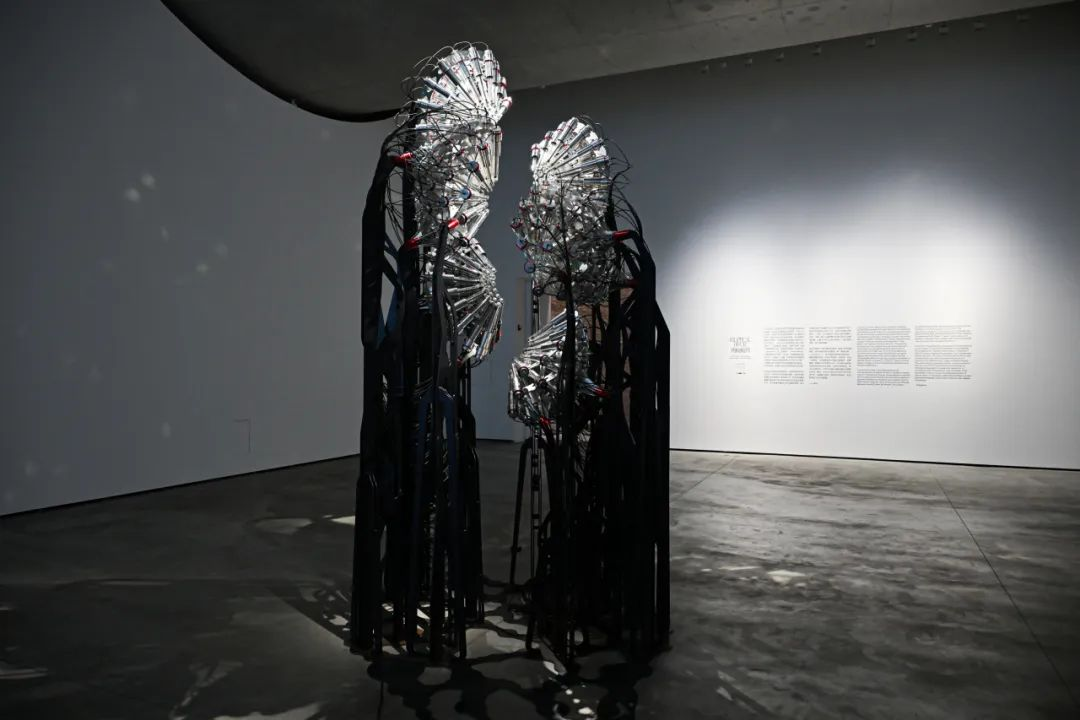
《阿尔戈斯》,我们与金允哲超自然现实的初次邂逅,宛如《2001太空漫游》中的巨型黑石,通过宇宙射线撞击地球大气,将天体的宏伟与日常的平庸串联在一起。在这人类居所与宇宙的遭遇中,源于古希腊的千眼巨型结构,配置了盖革-穆勒管仪器装置,扫描着缪子的所在-这种亚原子粒子是星际碰撞的结果-将其转化为声音和光线,并触发周围事件和物质的一连串行动与互动。它穿梭往复,横跨不同性态,尺度和属性的物质,实现的不仅是“物质的现实”,还有布鲁诺·拉图尔的“物质的关怀”,这样的互惠既有着物理与化学之必然要素,也为伦理与美学所不可或缺。
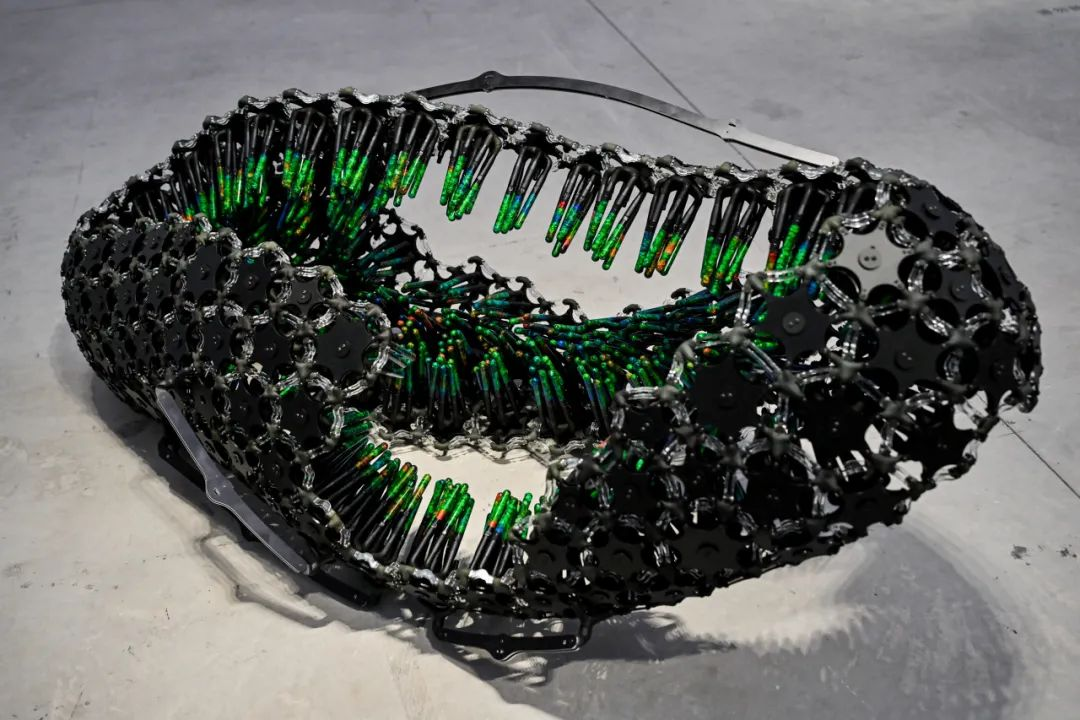
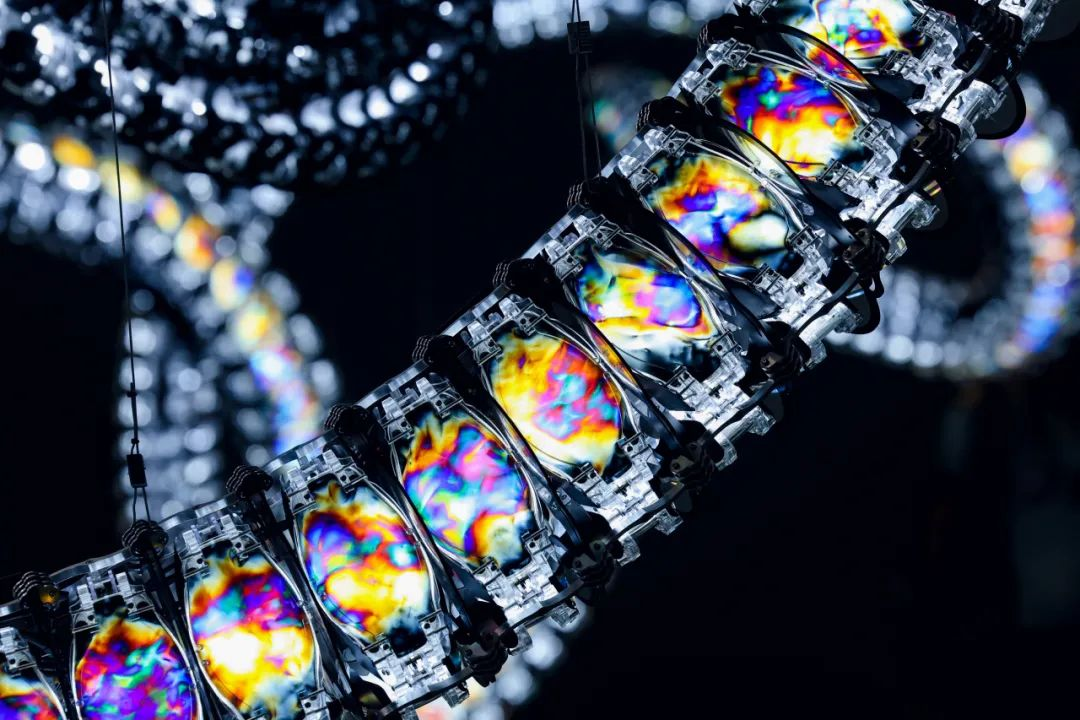
金允哲,《色度 IX》,“两极椭圆:情动的粒子及玄秘的流溢”,展览现场,798CUBE,2024。
法国科学哲学家加斯东·巴什拉(Gaston Bachelard)曾经说过:“实现先于现实”。用金允哲的话来说,是一种技术-物质现实先行于人类感官所察觉的真实。《色度IX》是一个庞大的缠结集合体,呈现为无限延伸的衔尾蛇形态,通过激发色彩斑斓的液体波动的现象,催生出一种现实。这是一件来自现代炼金士的神奇之物,承载着正负能量的交织,在不断沉淀和升腾中汇聚成两极椭圆。金允哲因此通过一种技术现象学之现象的实现向我们呈示了一种现实。这是由仪器产生的现象,如马克·汉森所说,“与人类的意识和感知没有必然的(遗传)关系。” 经由此,艺术家以其直觉消除了人类中心论的傲慢带来的缺陷,并把多样化的主体平等地放在了一起。
我们因而得以窥见金允哲的炼金术世界。
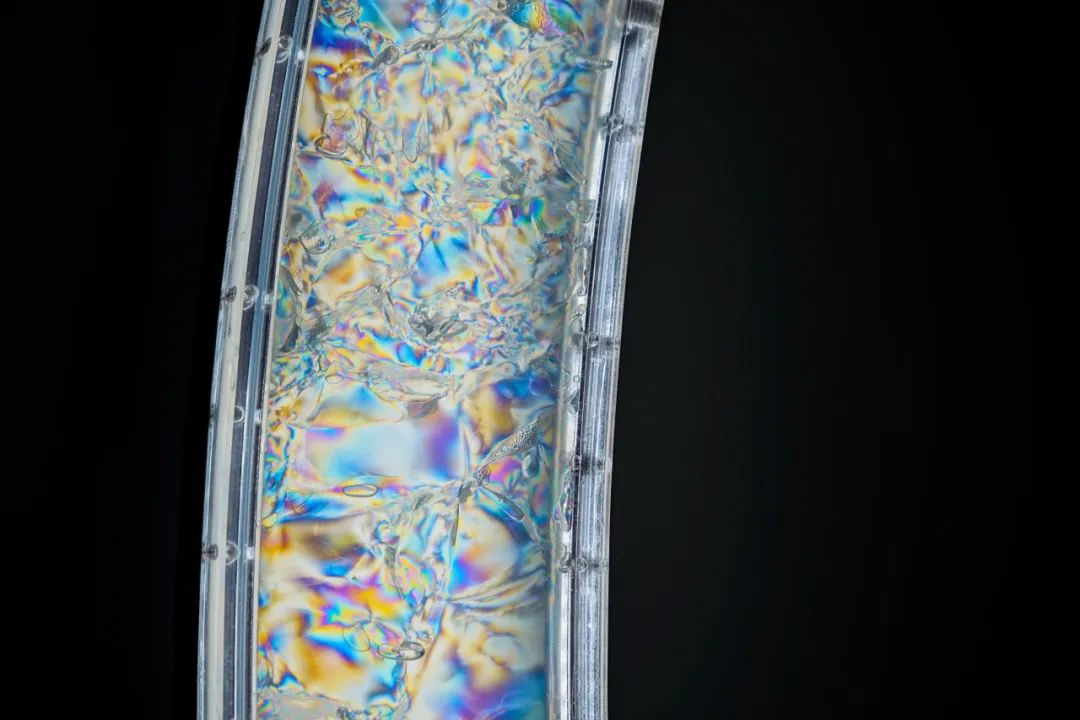
《不可名状之物 II》(2024年)揭示了金允哲在他的视觉魅力中创造的复杂构思和技艺。这并不是一种光学幻觉,奇妙的光谱和辉煌的强度是一种力量的物质化体现,既是人工所为也是有机物质,以海藻层制成的水凝胶形态固化。古老的挂毯技术和莫顿·费尔德曼(Morton Feldman)的渐进单音融入了艺术家想象力的超脱壮丽。《不可名状之物 II》的两个装置,在旷阔的展厅两端相互共鸣,在金允哲的玄学解释中,凸显出由偶极子作用所形成的椭圆之物质实体的“物质之喻”。这是永恒与瞬息并存,就像波和粒的量子力学启示一样,交融、爆发、穿透双缝,同时坐落在无限远与无穷近的彼岸。在这电磁承载的眩晕中,相对的力量获得平衡,抵达负熵式的静谧。
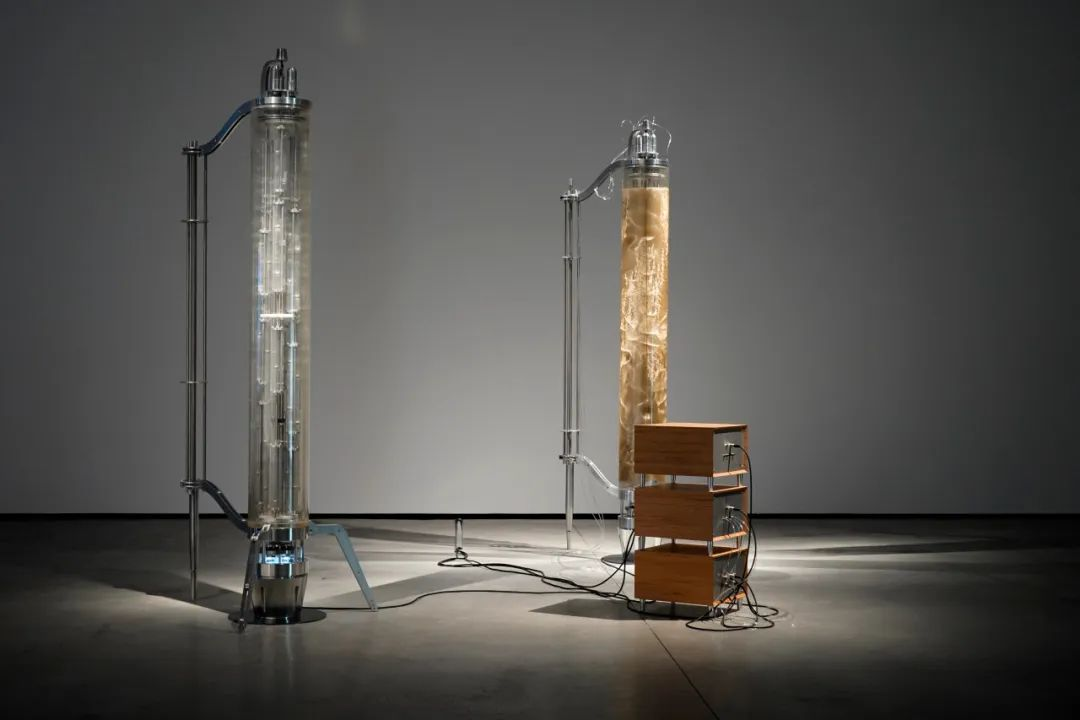
犹如优雅的竖琴,时钟般精确地编织着或和谐或失谐的涡旋,《三轴柱 II》是一座液体熔炉,将金属颗粒和沙砾残渣焚烧、转化为一个流体漩涡,将消解凝结成柔韧,上下翻涌着、螺旋缠绕着,将几何冲向无序,继而循环往复,不断地解体又再生。金允哲的三轴柱是持续的循环,是开放式的封闭,是互联的系统,亦是争论的解决方案。德国媒体理论家西格弗里德·齐林斯基(Siegfried Zielinski)可能会赞同,正是这种多节点强度和变体学的复调,构成了艺术家内心世界的主旋律。
如果说齐林斯基对“变体学”的复调阐述源于他通过媒体考古学的视角对“深层时间”的博大研究,那么金允哲作为这位多产的教授曾经的学生,不仅传承了导师对古今人类所持的多元世界观,也忠实地从岩石层化的矿物学角度来解读“变体学”的意蕴。岩石层化源于地质学的深邃,树木的纤维素组合,以及存活于深海底层的生物所致。在《岩层》(2024)中,艺术家探索了超越人类直接感知和文化概念的物质性真实,挖掘并揭示了肉眼无法看到的色彩深度。
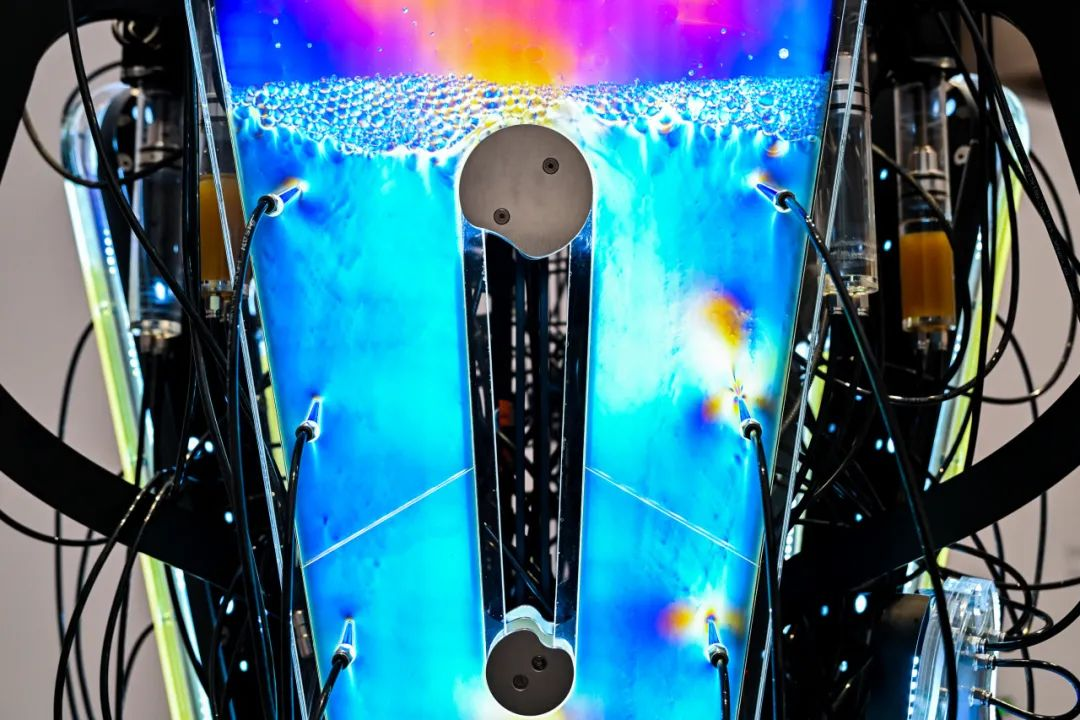
作为向雷蒙·鲁塞尔(Raymond Roussel)的致敬——这位法国诗人在艺术家成长的岁月里给予了金允哲诸多启发(艺术家以鲁塞尔的小说《Locus Solus(拉丁文:独一之所)》命名了自己的工作室),并长期促使他通过诗意、科学之外的遐想和自省对世界进行“玄学”的阐释,金允哲创造了一座活雕塑,并发明了一种由矿物颗粒组成的新物质,这种物质只能通过被巧妙地整合在六边形玻璃容器中的特制的透镜来观察。石质溶液从半透明容器内部的小喷口向上喷涌,仿佛渴望并拥抱着太阳引力,那一切生命的源泉。沸腾的液体将不稳定的能量转化为潜在的势能,实现了有机体和人造物同时的唤起与升华,将大地上所有不相融之矛盾的尘垢焚化为《太阳之尘》(2022)。
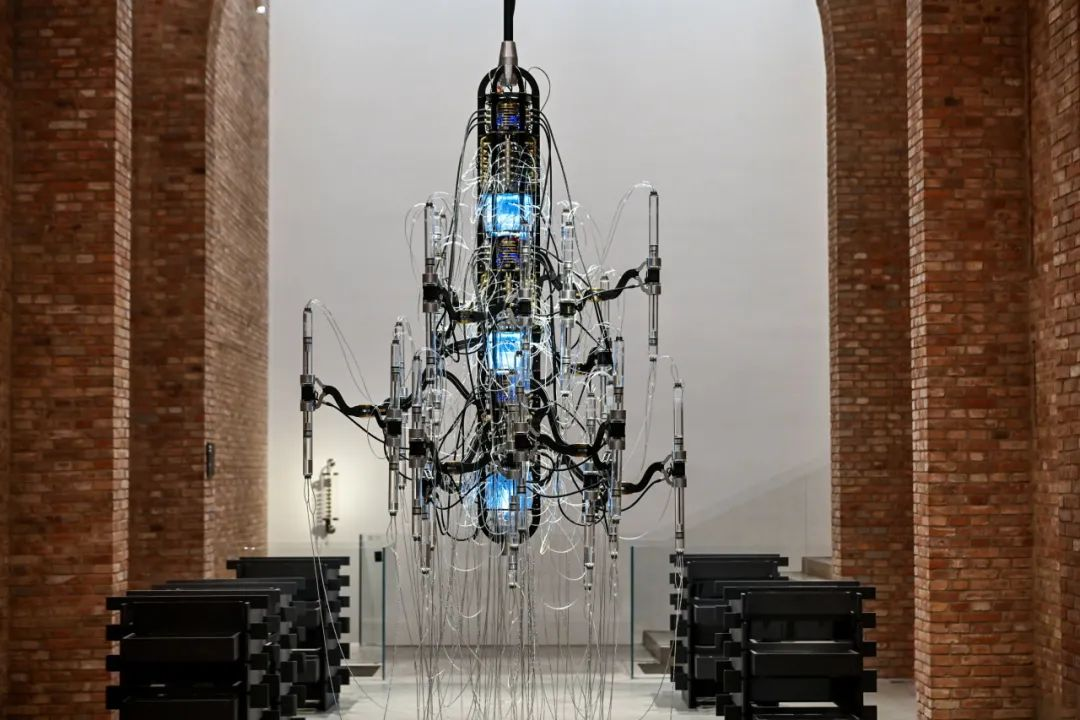
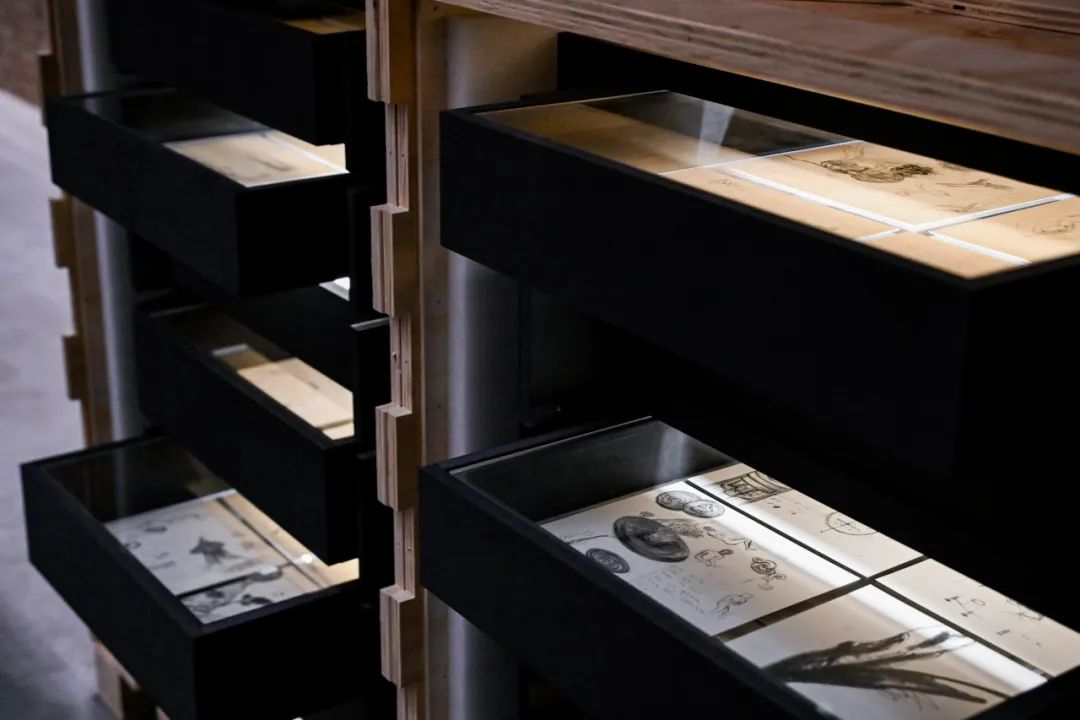
如果Locus Solus工作室是金允哲及其助手们演练金属、岩石和植物之奥秘的隐居之地,那么《残余的陈列》(2024)则为人们打开了探究其玄秘内室的一扇窗口。《残余的陈列》位于两层楼之间的拱廊空间,是一个存放着炼金士的各种物件档案的微型实验室,这些物什并不遵循传统的分类法,而是以物质的精度来划分,例如超越可见尺度之外的测绘,或是物质的不确定性,这种不确定性取决于温度、压力以及尚未从物体本身潜能中释放的弹力。各种类别的并置和互渗突破了传统以纲目,种类界定的分类系统。悬挂在上方的树形吊灯(《脉冲》,2018)仿佛是奇妙而又诡异之物的结晶,液压动力泵有如一棵活树的呼吸管道,脉动、共振,将生命输送给这个壮丽而内敛的音视奇观。
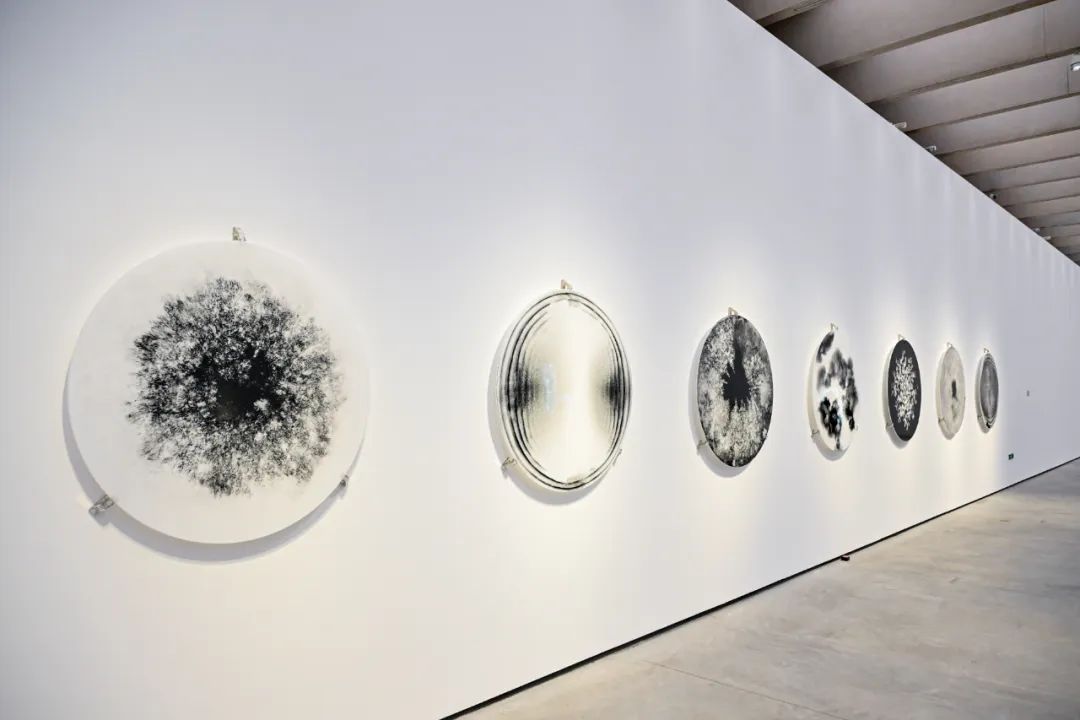
金允哲也作画,但他的绘画是一种新奇的、表演式行为。不妨称之为 “粒子绘画”,显现出艺术家在类似传统绘画或是洗印照片过程中的身体姿态。仿佛在揭开久远的地质变迁,这些肢体动作在显现微观世界的沉淀中透露出自然的轨迹。《残积层》(2024)如同印记在永恒中的行动,再次佐证了金允哲的唯物主义象征手法,在此,飘逸的瞬息在物质和时间中获得了不容置疑的定格。
金允哲既是一位视觉艺术家,也是一位出色的音乐家。他制作自己的设备来创作音乐:一种既是电声的音乐,也是经典的前卫音乐。他的唱盘式乐器《C-射线》是由化学反应器转化而来的合成器,可以将海水产生的电流放大为音频信号。声音通过一支由化学物特制的“铅笔”在铝板上刻写而产生。将那听不见的化为声音的物质痕迹。
金允哲回避了比喻与象征的便利,否决了符号学的威权。他的玄学必然要求一种“物质之喻” (matterphor),其本身拥有自我创生的动力,能够孕育和生成。他的世界是另一类世界,在这个世界里,只有超越理性之羁绊才能解开“两极椭圆”图像中无尽的极性之结。艺术家创造的神秘微粒在宇宙学与矿物学、生物学与地质学、单子论与辩证法、内在与矛盾的交融中激发出情感的流溢,最终,在生命与死亡的共同升华与永恒回归中,在吞噬人类和一切的原子漩涡中,金允哲找到了自己的慰藉。
Yunchul Kim thinks cosmologically and acts microphysically. He allows himself to indulge in cosmic reveries, meandering through the geophysical expanse and astrophysical immensity and permitting caprice in planetary temporality alongside the circadian cycle of earth-bound creatures. He is at once pre-scientifically abstruse, recalling when alchemistic enunciation proclaimed the divinity of a totality of the living and the undead, of solids and spirits, and in which the suprarational reigned in the domain of knowledge, and post-humanistically amorphous, by which homo sapiens is understood microbially in rapport with plants, and quantum mechanically in tandem with rocks and stones (we are all particles!).
Argos (2022), our first encounter with Kim’s preternatural reality, is reminiscent of the monolith in Space Odyssey that channels the celestial stupendous to the everyday profane by the violent act of cosmic rays striking the earth’s atmosphere. In this ultimate contact of the human abode with the cosmos, the thousand-eyed monumental structure originating in Greek antiquity, equipped with a modern apparatus of a Geiger Muller tube, scans muons, the subatomic particle that is the result of the interstellar collision, transforming into sounds and lights and setting in motion cluster of actions and interactions of things and substances in their vicinity – it crisscrosses, traversing matters of different natures, magnitude and properties, materializing not only matters of fact but also “matters of concern,” as Bruno Latour would have it, enabling a reciprocity that is both physi-chemically necessary and ethical-aesthetically indispensable.
The French philosopher of science Gaston Bachelard once stated that “realization takes precedence over reality,” that is, in Yunchul Kim’s parlance, a techno-matteReality which foregoes the real perceived by human sensory faculties. Chroma IX (2024), the colossal, knotted assemblage of a vastly elongated ouroboros form, engenders a reality coming into being through the very process of putting into action the phenomenon of fluctuation of the variegated liquid that is the marvelous work of a modern alchemist, of an entanglement of energies both positive and negative, converging into an elliptic dipole in sedimentation and ascension. Yunchul Kim hence presents to us a reality through the actualization of a techno-phenomenological phenomenon: phenomenon that is instrumentally produced and has “no genetic tie to human consciousness and perception.” (Mark Hansen, The Critique of Data) In doing so, the artist has intuitively undone the damage of anthropocentric hubris and made equal footing of varied and multitudinous subjectivities.
We get a glimpse into Yunchul Kim’s underworld of alchemy.
Amorph II (2024) reveals, shedding light on the intricate contrivance and technicality Yunchul Kim creates in his visual enchantment. Rather than an optical illusion, the wondrous spectrum and brilliant intensity are a manifestation of a materiality of forces, both artificial and organic, solidified in the form of hydrogel derived from layers of seaweeds. Ancient tapestry techniques and the progressive mono-tonality of Morton Feldman weave into the transcendental splendor of the artist’s imaginative mattereality. Two installations of Amorph II, resonating with each other across the expansive gallery space, in Yunchul Kim’s pataphysical explication, make salient a "matterphor" in the physicality of an ellipse enacted by dipoles. It is eternity reconciled with evanescence, like in the quantum mechanical revelation of waves and particles, commingling, erupting, penetrating the Double Slit to land both infinitely far and near all at once. In that vertigo of electromagnetic charges, opposite forces achieve an equilibrium and arrive at the negentropic tranquility.
As if two elegant harps were to orchestrate a vortex of harmony and dissonance with the mechanical precision and articulation of clockwork, Triaxial II (2017) is a liquid furnace that incinerates metal particles and sand residuals, turning them into a fluid gyre, coagulating dissolution into suppleness, winding up, twisting down, cochleated, rushing geometry into entropy and vice-versa, disintegrating and regenerating. Yunchul Kim’s piece is cyclicity, open-ended closure, a system of reciprocity and a resolution of the polemic. It is this polyphony of multi-nodal intensity and Variantology, as German Media theorist Siegfried Zielinski might concur, that forms the leitmotif of the artist’s inner chamber.
If Zielinski’s polyphonic articulation on Variantology stems from his erudite study of Deep Time through the lens of media archeology, Yunchul Kim, once a student of the prolific professor, inherits not only his mentor’s pluralist worldview of humans ancient and modern, but also takes the word very literally in the mineralogical sense of stratification of rocks in light of geological immensity and with the cellulose composition of trees that enliven, and of that which subsists at the bottom of the deep ocean. In Strata (2024), the artist explores material verity that is beyond immediate human perception and cultural conception, excavating and unveiling the depth of pigmentation unseen by a naked eye.
In an homage to Raymond Roussel, the French poet who has inspired the artist during his formative years and alongside his prolonged pataphysical elucidation of the world through poetic, extra-scientific reveries and introspections (the artist named his studio after Roussel’s novel Locus Solus), Yunchul Kim has created a living sculpture, inventing a new substance granulated from minerals that can only be viewed by custom-designed lenses subtly integrated into hexagonal glass containers. Stony liquids gush from small jets inside the translucent vessel, arising upward as if longing for and embracing solar gravity, the source of all life. Transmuting and transforming the unstable into the potential, the boiling liquid culminates in the co-arousal and co-ascension of the organic and the artificial, incinerating all that are incommensurable and contradictory of the grime of the earth into the Dust of the Sun (La Poussiere de Soleils III, 2022).
If Studio Locus Solus is the hermitage where Yunchul Kim and his assistants exercise their arcana of metal, stone and vegetation, Remnant Vitrine (2024) opens a window unto the sorcerous inside. Nested in an alcove in the mezzanine area, the Remnant Vitrine is a miniature laboratory that hosts a medley of the alchemist’s archive of things, objects not following the convention of classification, but alongside the exactitude of materiality such as measurements beyond the apparently visible or matter’s indeterminacy contingent on temperature, pressure, and the elasticity that’s yet to be unleashed from the potentiality of the thing itself. The juxtaposition and infiltration of varied categories defy the taxonomy of species, genus, family, order, class, phylum, kingdom, domain, etc. The chandelier of magic (Impulse) hanging above appears as a crystallization of wondrous and uncanny things, its hydraulically powered pumps resemble the respiratory connectedness of a living tree, pulsating and resonating, circulating liveliness throughout in an audio-visual spectacle both sublime and subliminal.
Yunchul Kim paints, too, but in an uncanny stunt of painterly action. Call it particle painting; it embodies the artist’s somatic gestures that transpire in a process analogous to conventional painting or photo developing. Yet, it is also akin to unveiling the vicissitude of geological eternity. The bodily movement unpacks the trajectories of nature in the epiphany of microscopic rudiments. Eluvial Horizon (2024) reaffirms Yunchul Kim’s materialistic symbolism as action carved in longevity, here the ephemeral has acquired its indisputable manifestation in physicality and temporality.
As much a visual artist as an accomplished musician, Yunchul Kim constructs his own devices to make music that is electronically acoustic and classically avant-garde. His turntable-styled instrument C-Ray is a chemical reactor turned synthesizer which amplifies the seawater-generated electrical currents into audio signals. Sound is produced by a chemically infused “writing pencil,” inscribing onto an aluminum plate. It is a material imprint that materializes the inaudible.
Yunchul Kim eschews the convenience of a metaphorical toolkit, defies the dictatorial sovereign of the Signifier. His pataphysical imperative demands a "matterphor" that is capable of agential autopoiesis, that impregnates and brings forth. His world is otherworldly in which only surrationalism can untie the never-ending knot of polarity in the mesmerizing image of Elliptical Dipole. The artist’s mystic granules thus stir up emotive flux in the concurrence of cosmology and mineralogy, of biology and geology; of monad and dialectics, of immanence and contradiction; and ultimately, of life and death in the co-rising of the ascending flare of eternal return, in the atomic vortex that swallows humans and everything else, Yunchul Kim finds his own respite and solace.
艺术家/Artist
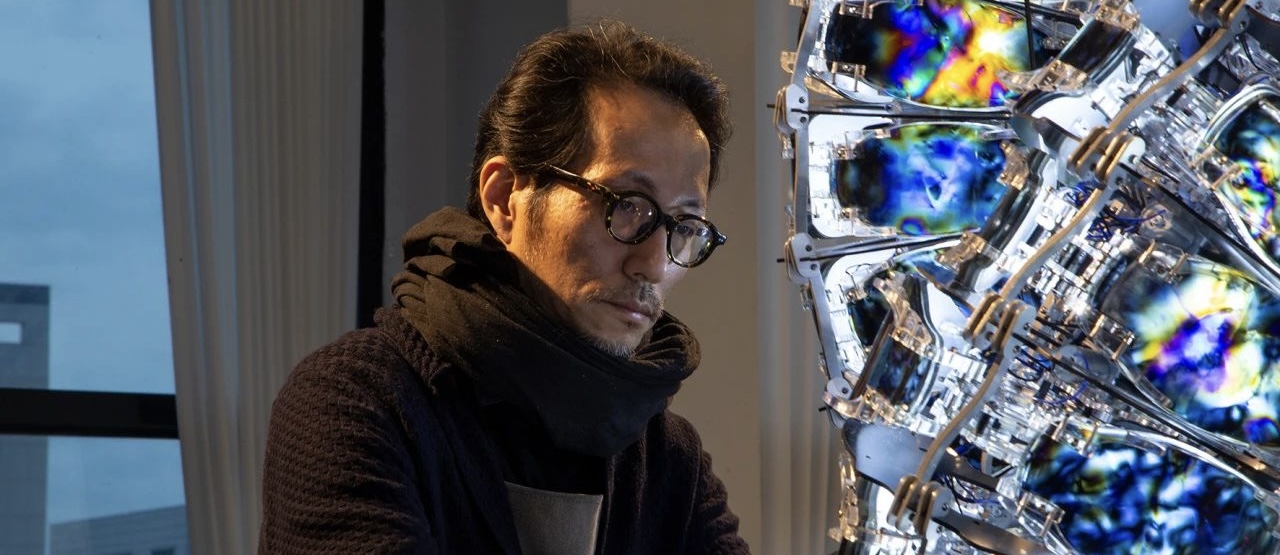
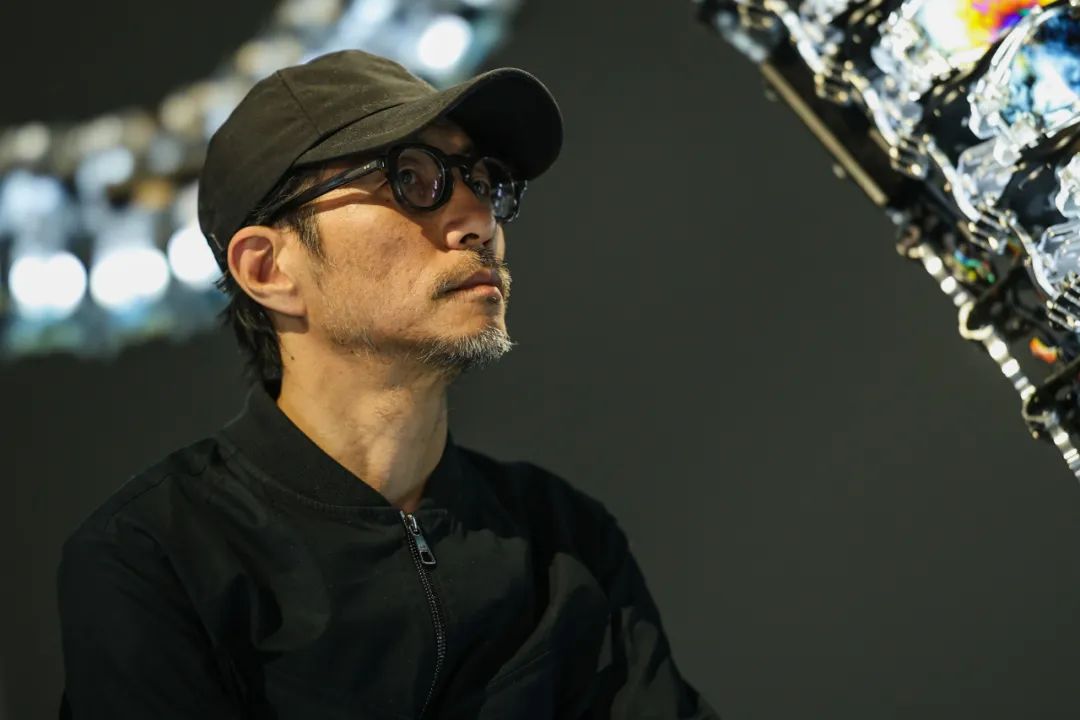
金允哲是一位艺术家和电声音乐作曲家。通过对“物质”和“物质性”提出根本性问题,艺术家展示了想象力和创造一个超越人类既有经验之真实的可能性,并关注其潜在的趋势。其作品展现了艺术家想象的物质世界,是一个在人类文化形成或被语言定义之前的维度中的故事。人类、非人类、机器、材料和物质被平等地视为活性物质(跨物质)和事件主体,存在于其作品当中。
金允哲曾获得多个国际奖项,包括2016年欧洲核子研究中心(CERN)的碰撞国际大奖、林茨电子艺术大奖(Ars Electronica)和 VIDA 15.0 三等奖等。其作品也曾在世界多地展出,包括第59届威尼斯双年展韩国馆(意大利)、巴塞罗那当代文化中心(CCCB,西班牙)、FACT利物浦(英国)、林茨电子艺术中心(奥地利)、法兰克福艺术协会(德国)和国际新媒体艺术三年展(中国)等。他曾担任韩国高等研究院(KIAS)跨学科研究项目“物质现实”(Mattereality)研究组的首席研究员。此外,他还是艺术与科学项目组“流体天空”(Fluid Skies)以及奥地利维也纳应用艺术大学艺术与科学系的“液体物质”(Liquid Things)艺术研究项目的团队成员。
Yunchul Kim is an artist and electroacoustic music composer. Asking fundamental questions about “material” and “materiality”, he has demonstrated the possibilities of imagination and the creation of a reality beyond the realm of human experience, paying attention to its potential tendencies. His work embodies the material world imagined by the artist and is a story of a dimension before humans formed cultures or were defined by language. His works, in which humans, non-humans, machines, materials, and substances are considered equal, exist as active matter (transmattering) as the subject of events.
He has won international awards, including the 2016 Collide International Award from CERN, Ars Electronica, and the VIDA 15.0 Third Prize. His works have been presented by a number of prestigious international organizations, including the Korean Pavilion, 59th La Biennale di Venezia, Italy; CCCB, Spain; FACT Liverpool, UK; Ars Electronica, Austria; Frankfurter Knstverein, Germany; and International Triennial New Media Art Exhibition, China. He was chief researcher of the research group Mattereality at the Transdisciplinary Research Program at the Korea Institute for Advanced Study. He is a member of the art and science project group Fluid Skies and Liquid Things, an artistic research project at the University of Applied Arts, Vienna, Austria.
策展人/Curator
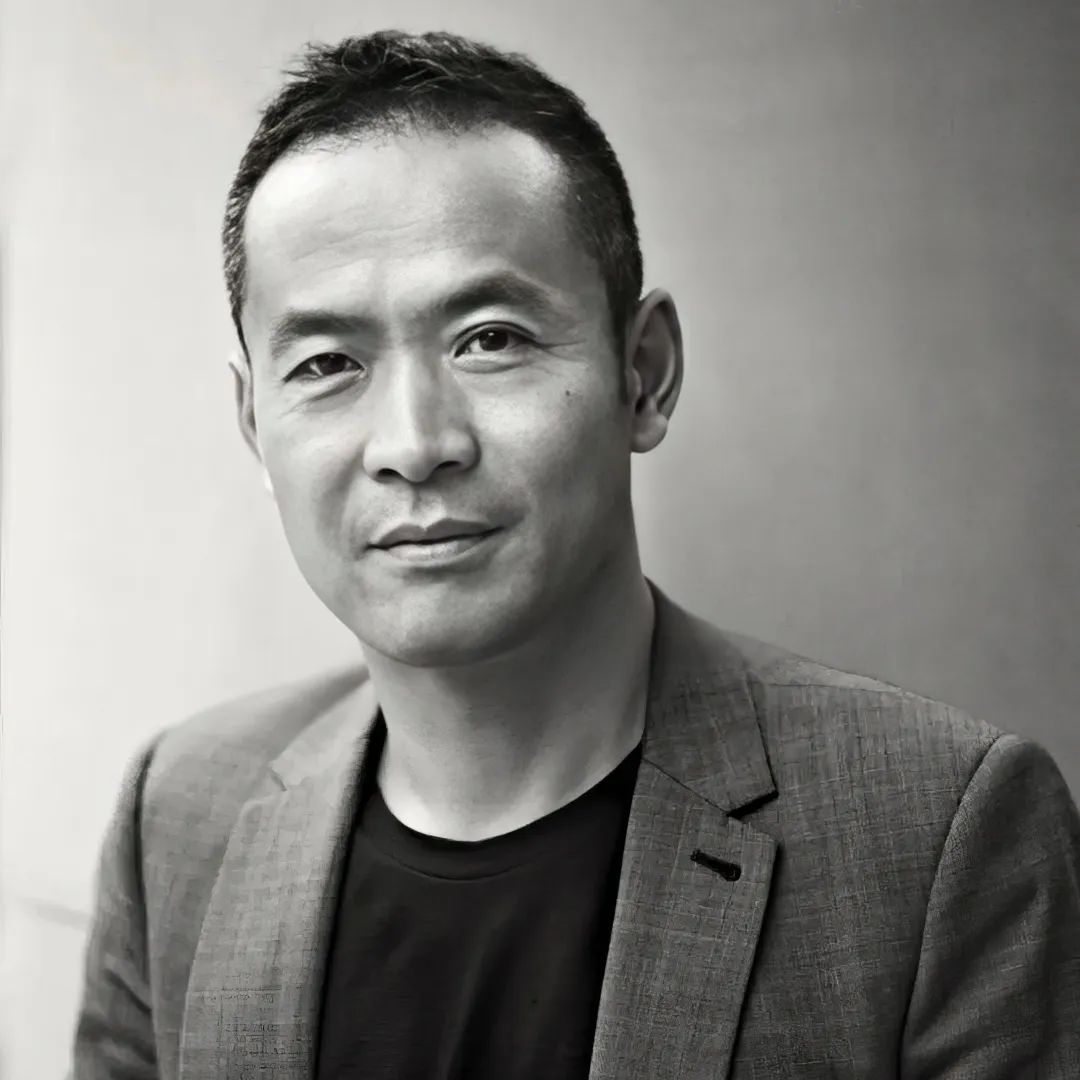
张尕,媒体艺术策展人。曾策划中国美术馆媒体艺术三年展系列(2008—2014)等。近期策展项目包括“混韵之宇:王郁洋个展”(深圳美术馆,2024)、“动为行:中国媒体艺术35年”(天目里,2023)、“真实的拓扑”(深圳两馆,2023)、“第6届广州三年展”(联合策展,广东美术馆,2018)、“Datumsoria:真实的复归”(ZKM,2017)等。其写作及所编书目由多家出版社出版。张尕目前为中央美术学院特聘教授。自2015年起,他亦担任上海新时线媒体艺术中心艺术指导。
Zhang Ga is a media art curator. He was curator of three editions of Media Art Triennial (National Art Museum of China, 2008-2014). His recent curatorial projects include Chaosmosis: A WANG Yuyang Exhibition (Shenzhen Art Museum, 2024), Motion Is Action: 35 Years of Chinese Media Art (By Art Matters, 2023), Topologies of the Real (MoCAUP, 2023), The 6th Guangzhou Triennial (co-curator, GDMOA, 2018), and Datumsoria: The Return of the Real (ZKM, 2017). His publications include edited books and essays. He is currently Distinguished Professor at Central Academy of Fine Arts. Since 2015, he directs Chronus Art Center in Shanghai.
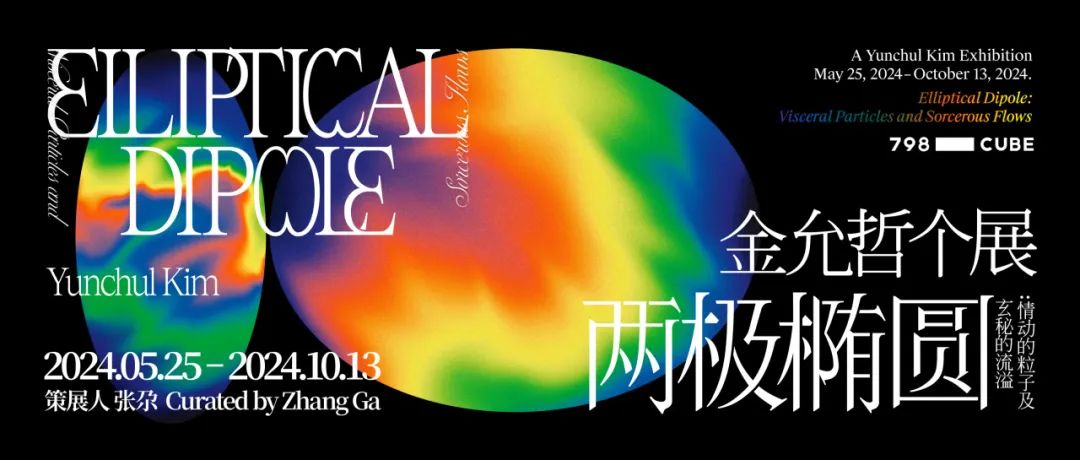
两极椭圆
情动的粒子及玄秘的流溢
扫码购票
展览日期
2024.5.25-10.13
开放时间
10:00-19:00
(最后入馆时间18:30)



 Publish
 Videos
 Articles
 Events
 EN
EN





Comments
Please Log in or Register to comment