


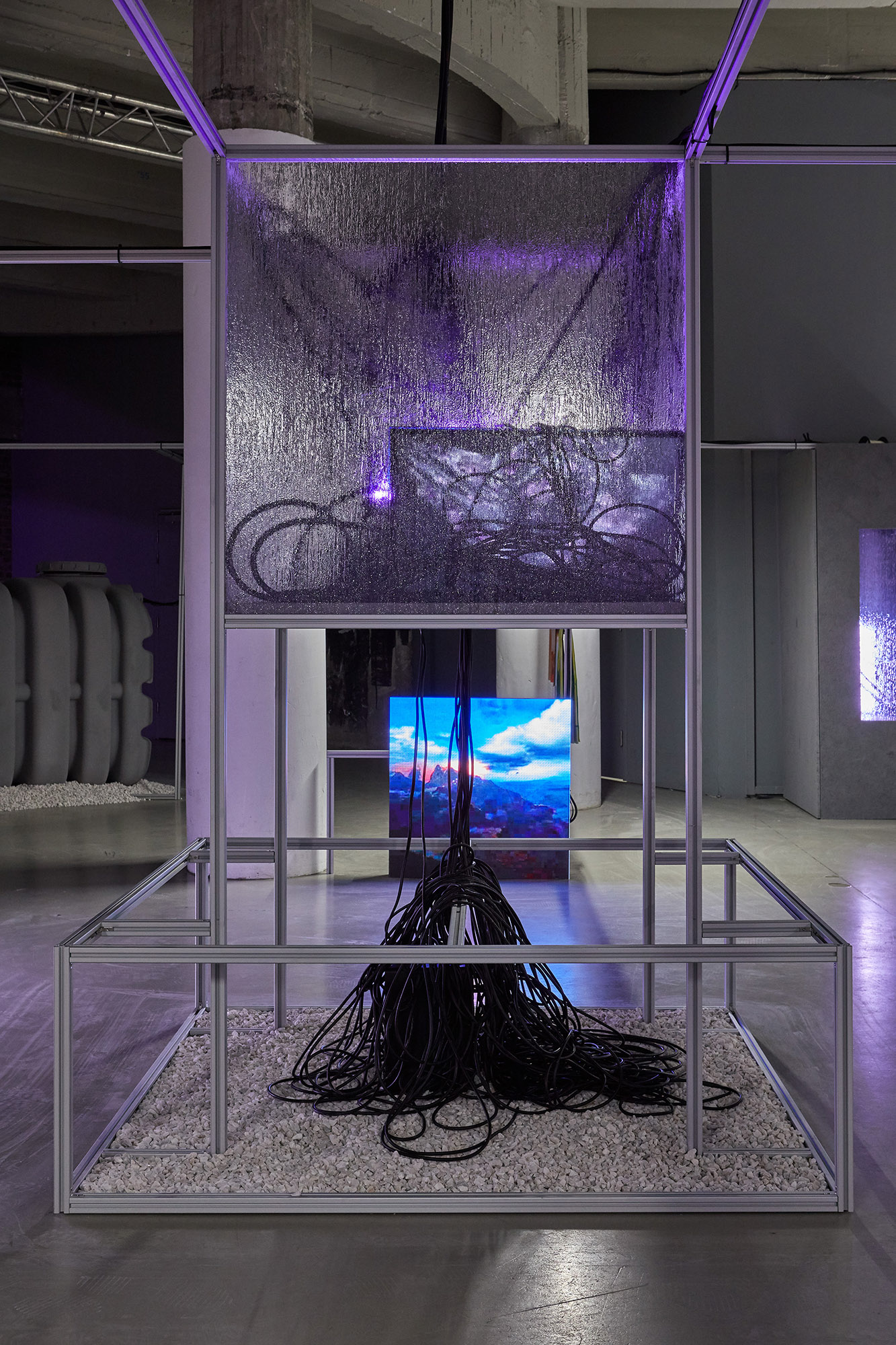
We will sketch here too briefly a definition of postcontemporary art, the object of which will not be to add a new fetish word to the panoply of discourses, but to respond in some way to the notion of contemporary art that remains dominant. Let it be immediately pointed out that the author is not an art historian or critic, but an artist, and that his point of view is thus involved, rather than engaged, in a practice that undoubtedly overdetermines the definition he will propose. But he would like his reflection not to be limited to illustrating his practice and to serve as a possible, and only possible, reading of a turning point in time.
Artistic production can be considered as being constituted around temporal narratives. Each epoch seems to have constructed a relationship to a time other than its own, dissociating and associating itself, according to a sometimes messianic promise, and to have « used » artistic representations to propose an image of it. It is not that one must identify an epoch with a given temporal narrative, but rather that several temporalities coexist in the same epoch, which we must consider as shifting polarities whose relationships define the tone of the epoch.
We are going to sweep away sections of history that would deserve infinitely more precise developments, but we are pursuing an objective that is not that of a historian.
If Christian painting has given itself as the repetition of the Way of the Cross, it is because each believer should follow, that is to say repeat, the passion of Christ, a past event that must return unceasingly (the Christian body does not cease to flow through the stigmata). This repetition could never take place identically, the initial path remains irreducible, but at least it made it possible to orient the Christian’s existence. Certain pictorial representations of the Renaissance, for their part, show an ancient ideal, rediscovered from the Ancients, a repetition here again of a rebirth which is also a first time. It is a past that does not pass away because it was not fully realized and it must finally be brought to the present to make it identical to itself. Modernity constructed time as a future promising emancipation and artists appeared to be in the vanguard of these changes towards greater autonomy, so that the autonomy of the medium, for example through abstraction, and autonomy as freedom of the individual were identified. Contemporary art was finally the adhesion of the present having itself. Becoming contemporary to oneself in the face of the collapse of modern promises, an amused look at those speeches and images that only promised. Disillusionment, end of party. All that remains is the present in its actuality, the flood of advertisements and industrial objects, whose waste must be seized to desimplify them and help, at least, to understand and feel this present of which we are woven.
These narratives, suggested here, are second times, as there is a second Earth, syncopated times that split the present in two, putting it in relation to another where the relationship sometimes goes upstream or downstream.
In recent years, contemporary art has appeared to some people as excessively cynical, sometimes foolishly decorative, repeating certain aesthetic commonplaces, and often having a part to play in the financial economy, so much so that it has lost all strength of shift and reflexivity. The adherence of the present with itself, which allows us to define the contemporary, then appears to have become a bad strategy for understanding the return of historical dramas, wars, environmental crises, etc.
Some artists, without always conceptualizing it as such, have developed a time that is already no longer contemporary. These are often strange environments, where the human being is absent, and which mix natural and technical organizations as if the difference between the two no longer held in their autonomy towards us.
What is this weather like? Strictly speaking, it is after the contemporary: these environments are placed after our present, in a future that is no longer that of modernity, because its driving force is no longer the will of the human collective. The present no longer promises the future, it is the future that determines the present. It is a future that could be near or far, it doesn’t matter, because its nature is less temporal than structural: we are not there, our species has disappeared and now only the technical, that is to say logistical, traces of what we were remain, only our waste, some of which may be endowed with a quasi-autonomy of movement. They continue to move without us, without witnesses, without anyone. Almost alive, zombie technique. The industrial revolution has endowed us with a power haunted by a thousand technical ghosts surrounding us without our knowledge.
An exhibition could then be strictly defined as a space for projection into this uncertain future, and we look forward to it because precisely this gaze, the human gaze, will have been absent from it. We imagine the absence of our gaze, our eyes become hollowed out not by blindness, but by the doubling of the absence. We advance in a geological space, there are the ruins of the datacenters, a residual computer activity, but who would be able to decipher its presence? The stones are lying on the ground in an eternity that is not for anyone. Images scroll by, a synthesis of this past memory accumulated on the Internet. An organism or a disease is perpetuated without anyone knowing it.
Postcontemporary art is to be understood as a future without us and it is paradoxically the speculation of this absence that allows reflection on our present condition, because the present can no longer be approached in its contemporaneity without repeating the domination of which it is the object. It must be shifted not only temporally, but also anthropologically. The question is no longer even that of survival because this will is not unrelated to the evil it wished to resolve. The human species has thus disappeared. There will be so much left of what we once were. But they will be destined for no one. The Earth will be emptied of our presence and this gaping void allows us to better perceive the involutive, disnovative movement blurring the boundaries between the organic and the inorganic, the living and the dead, of which we are the subjects and the objects. The autonomy of the without us is very different from the Greenbergian autonomy or the sublime Burkian and Kantian. It allows us to intuit the unravelling, that is to say the absolute. So this is our era. His memory, again.



 Publish
 Videos
 Articles
 Events
 EN
EN
Comments
Please Log in or Register to comment