


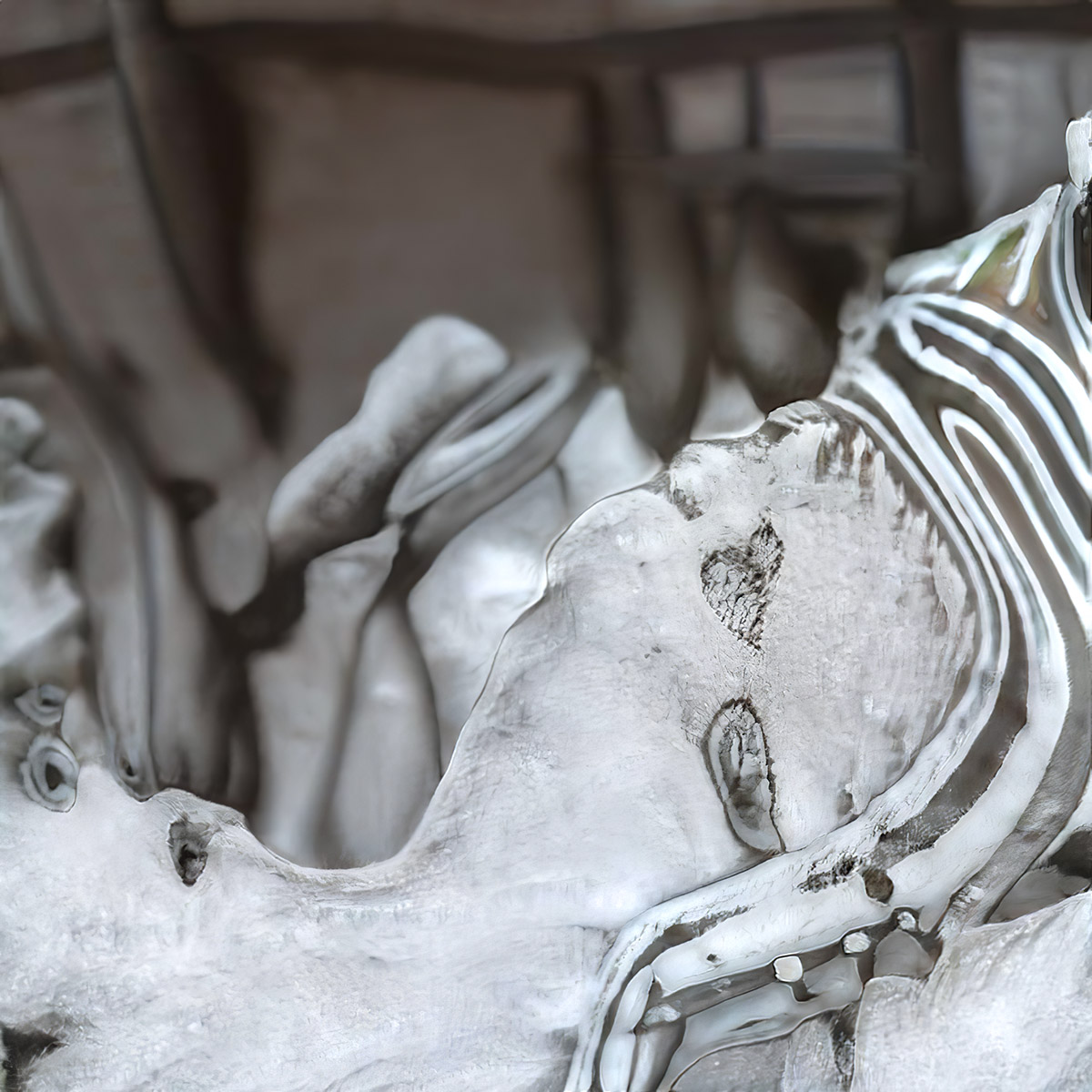
The generative art we speak of to designate programmed devices that generate always different results, evokes a properly poetic form (poïésis) in the sense not only of the production of a work of art, but of a « cause that, whatever the thing considered, makes it pass from non-being to being » (Le Banquet, 205 b). The genealogy of the concept of generation is complex. It must be linked to the question of the living and reproduction (Aristotle). Generative art is at the crossroads of technique, nature and art, which would be founded by the community of an unceasing production bringing creation to infinity. There is something diemurgic here, placing art on the side of a creation at the level of nature, a generation that should be reread with the help of the romantic ideal.
This art that never ceases to be created and to become, in the Parmenidian sense, is a flow understood as continuous fluidity making it impossible to stop, capture, seize, stabilize. It allows us to envisage a pure creative act and, in short, a form of purity and innocence of becoming. It may lead us to believe that computer programming makes art pass to the side of nature and that we thus let the thing itself happen, something autonomous that unfolds before our eyes, whether those eyes are those of the alleged author or of the public, but which could also unfold without any witnesses. A number of installations dig this furrow in the naturalness of the code by taking the plant, the sky, the liquid, etc. as a metaphor.
This overlooks both the infrastructural and cultural conditions of these productions, which mobilize a significant amount of logistics. Because for there to be processors, for there to be electricity, for there to be even a place of monstration, there has to be a whole system of references and instrumentation where the question of autonomy and the thing itself becomes difficult to defend. It is not only a question of the autonomy of generative art, but also of everything else, including the human being. It takes a complex system with multiple interactions for all this to take place.
From a cultural point of view, the occultation is even greater, because not only the programming of lines of code, the models available to generate, and the preliminary data are not accidents, but constitute the practical reality of the generative work. Historically, considering nature as something autonomous, living, complex, and retroactive constitutes an ideologically determined moment.
In such productions, randomness is also often confused with contingent, variation with what is outlawed. I will come back to this in another text.
I would therefore like to propose replacing the term generative art with that of degenerative art. If the reference to degenerative art is explicit, it should be added that degenerative is not on the side of a fluid flow, but a tumultuous flow, in the Lucretian sense, which can be rapid as it can slow down to the unstable halt of a drying up or mineral matter. The de-generative generates and degenerates, there is in it living and morbid, neguentropy and entropy, to put it another way of saying virtual and possible. There is no reason to value only emergence, the positive, life, while concealing destruction, extinction and nothingness. The degenerative art makes it possible to make sensitive the inextricability of these polarities.
It also points out the conditions of possibilities for the emergence of what I would like to call the effect of autonomy. If we take the example of AI, it is possible as a statistical induction because there has been an accumulation of data on the web, and this accumulation is indicative of the extreme heteronomy in which the species has and has been placed. If AI gives the impression of an autonomy that is taking place before our eyes, it is at the price of an extreme heteronomy whose autonomy effect is memory and trace. The notion of generative can be reproached for bringing the creative act back to life in its purity, was it ever considered non-human. The degenerative seems to us to recall the material, social and cultural background of these devices. With neural networks, we degenerate existential data. The degenerative is then closer to what happens: a finitude brought to its infinity in the disorder of an inspiration and an expiration.



 Publish
 Videos
 Articles
 Events
 EN
EN
Comments
Please Log in or Register to comment